
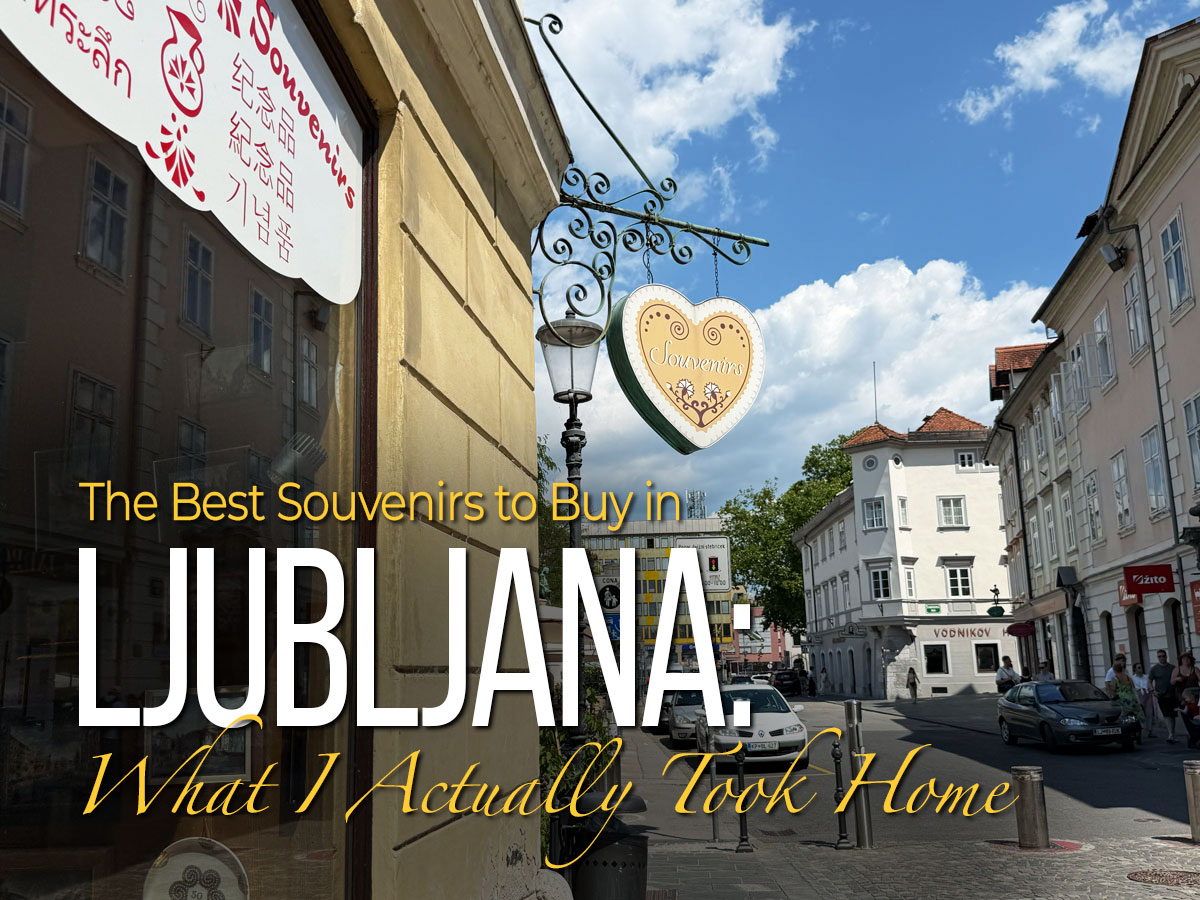
I went into Ljubljana with the usual low expectations for souvenir shopping — the kind of trip where you brace yourself for shelves of generic magnets and shot glasses with a country’s name slapped on. Instead I found a city where most of what’s for sale actually connects to something real: a 700-year-old salt-harvesting tradition, a bee species Slovenia is famous for protecting, a UNESCO-listed lace craft. Here’s exactly what I bought, what it cost, and the story behind each thing, in case you want to shop with intention instead of grabbing whatever’s closest to the till.
Quick Facts: Souvenir Shopping in Ljubljana
BEST BUDGET BUY: Piran salt pouches, from 6.50 EUR
BEST SPLURGE: Piran salt gift set, 27.90 EUR
MOST DISTINCTLY LOCAL: Idrija lace and Carniolan honey products
WHERE TO SHOP: Old town streets, Central Market, and dedicated craft shops
CURRENCY: Euro (EUR) — Slovenia has used the euro since 2007
TIPPING ON PURCHASES: Not expected or customary in Slovenian shops
1. Piran Sea Salt
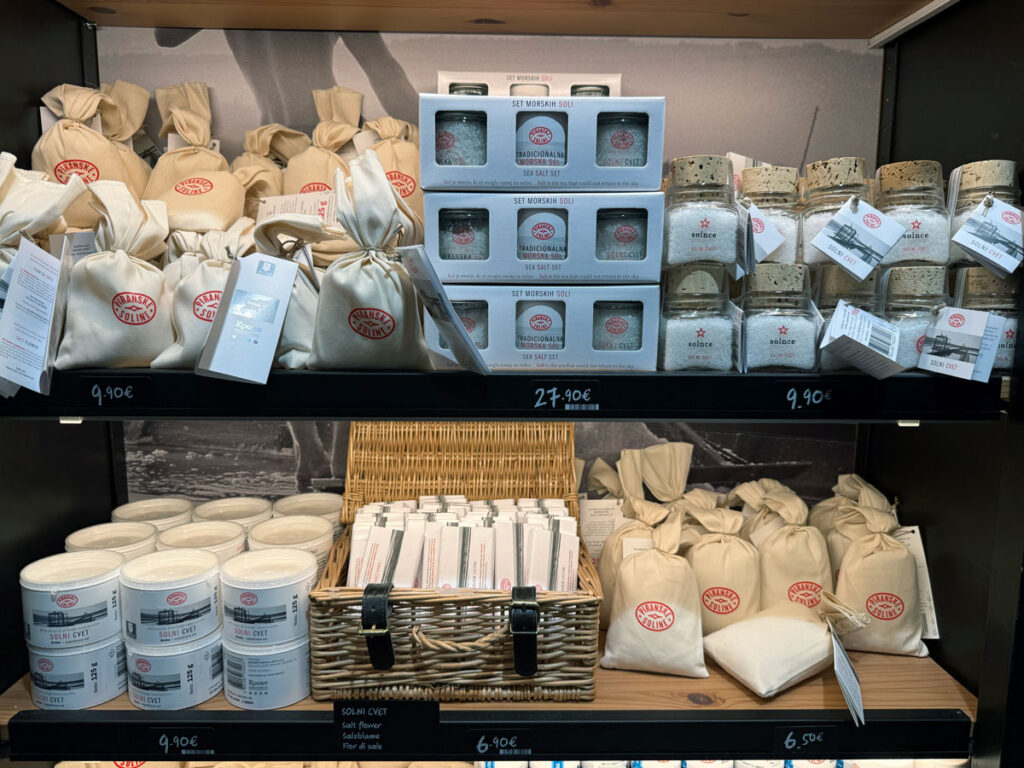
This was my first Ljubljana purchase and still my favorite. Piranske Soline is salt harvested at the Sečovlje Salina, on Slovenia’s short coastline near Piran, using a method that hasn’t meaningfully changed since the 14th century — seawater moved through evaporation basins by gravity, then hand-raked into crystals with wooden tools. The prized version is Solni Cvet, the “salt flower” or fleur de sel, skimmed by hand off the top of the crystallization basins using a wire-mesh scraper. It’s one of the last places in the Mediterranean still doing this by hand rather than by machine.
In the shop, a small linen pouch runs about 6.50–6.90 EUR, tins of Solni Cvet are 9.90 EUR, and a full boxed gift set with three types of salt was 27.90 EUR. It’s genuinely useful, doesn’t spoil, and packs flat in a suitcase — about as close to a “can’t go wrong” souvenir as this trip had.
Read more: First Time in Ljubljana? Everything You Need to Know Before You Go
2. Slovenian Honey and Beeswax Candles
Slovenia takes beekeeping seriously in a way that surprised me. It’s home to the Carniolan honey bee, a native subspecies now kept by beekeepers worldwide for its gentle temperament, and to Anton Janša, the 18th-century beekeeper often credited as the first formal teacher of modern apiculture. Slovenia has more beekeepers per capita than any other country, and it was Slovenia that proposed May 20th — Janša’s birthday — as World Bee Day to the United Nations.
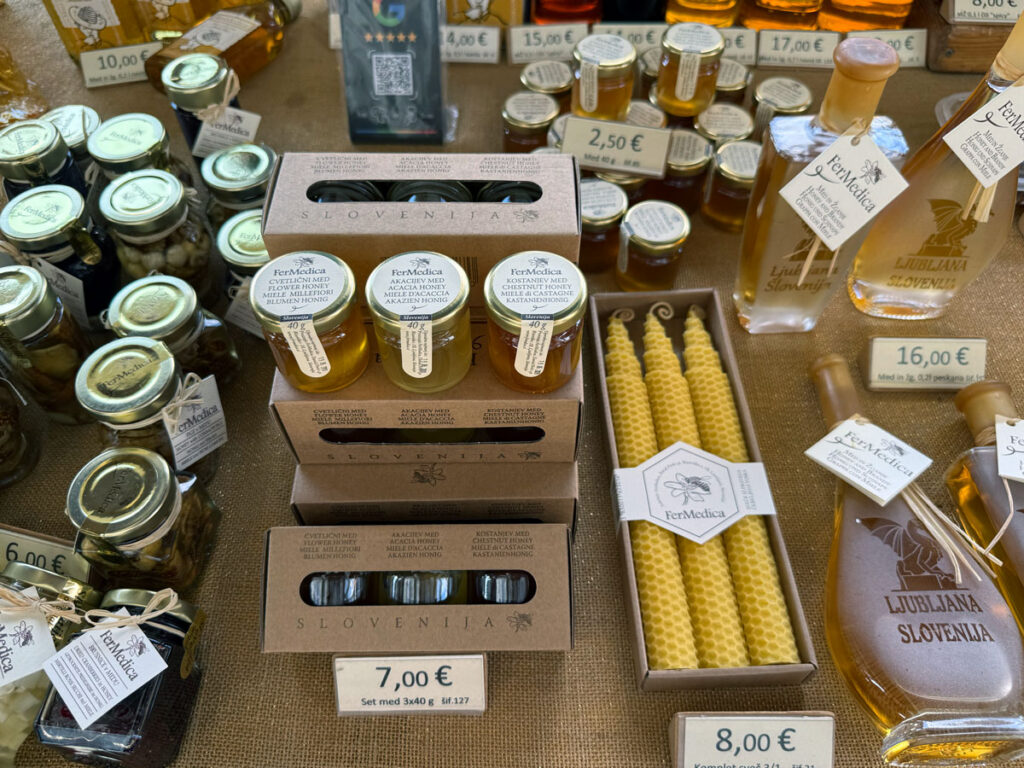
All of that context made a jar of honey feel like a more meaningful buy than it should have. I picked up a mini gift set of three 40g jars (flower, acacia, and chestnut honey) for 7 EUR, and a small box of hand-rolled beeswax candles for 8 EUR. Honey liqueur bottles, a traditional Slovenian spirit, ran from 16 EUR. Individual honey jars ranged from about 2.50 EUR for a small sample size up to 17 EUR for larger specialty jars.
Read more: My Ljubljana River Cruise Experience
3. Carniola Chocolate with Ljubljana Landmarks
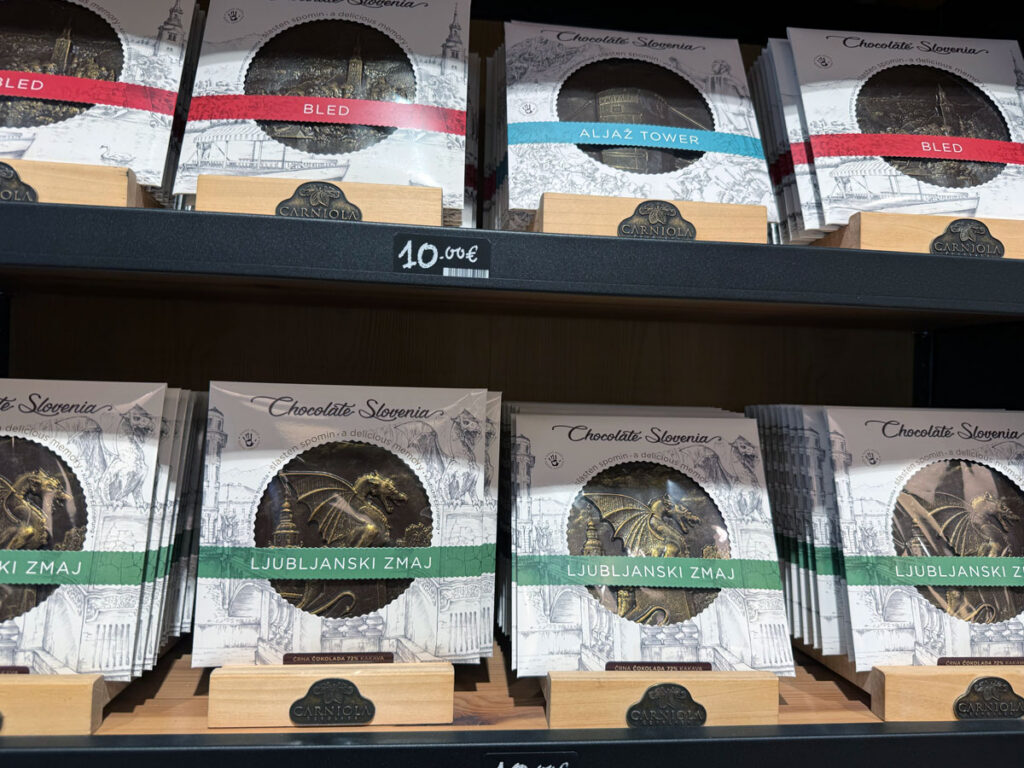
Carniola is a real Slovenian chocolate maker, and their landmark series is genuinely well done — each 72% dark chocolate bar has a different Slovenian landmark embossed on the front in gold relief: Lake Bled, the Aljaž Tower marking the summit of Mount Triglav, and the Ljubljana dragon, the city’s official symbol since the Baroque era. The dragon design in particular ties directly to the Dragon Bridge, opened in 1901 as one of the first reinforced concrete bridges built in Europe. Each bar was 10 EUR, and it’s the kind of gift that doubles as a tiny history lesson.
TIP
Buy the chocolate last, or keep it somewhere cool if you’re not flying home immediately — a 72% dark chocolate bar with detailed embossing doesn’t love a hot bag or a sunny windowsill.
4. Wooden Folk Art and Idrija Lace
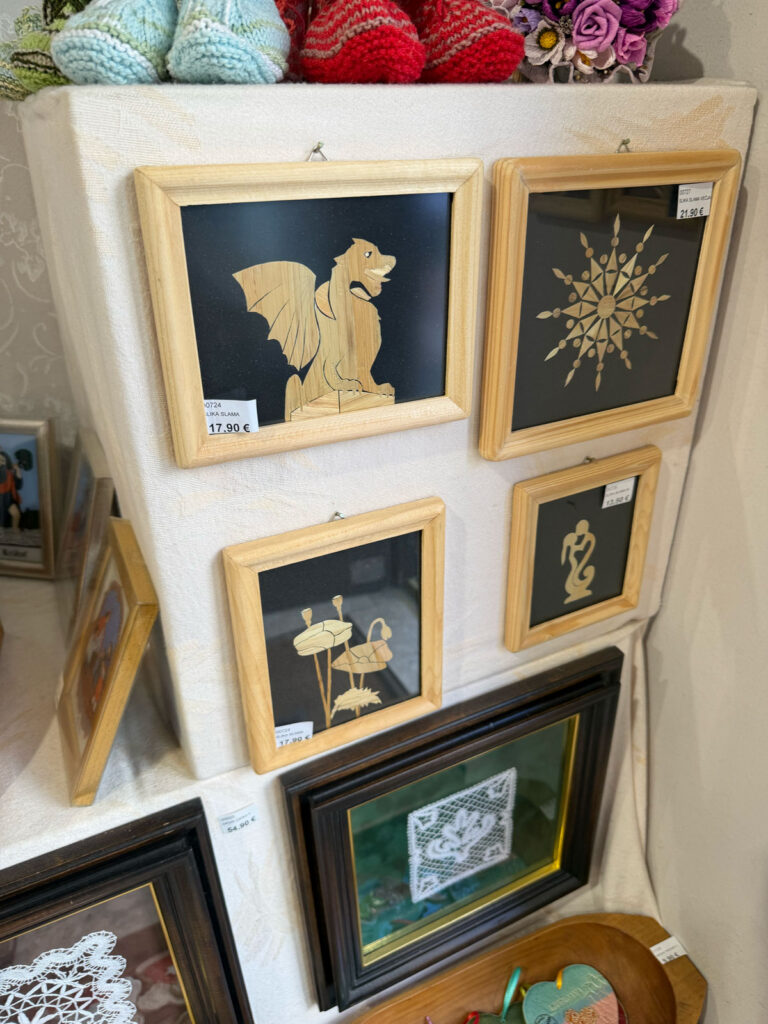
This was the most “craft-forward” corner of my shopping, and it’s worth knowing what you’re actually looking at. The delicate white lace pieces are Idrija lace, bobbin lace that’s been handmade in the town of Idrija since the late 17th century, when miners’ wives took up the craft. It’s since been inscribed on UNESCO’s Representative List of the Intangible Cultural Heritage of Humanity, and traditional patterns even have their own folk names — srčkovke, meaning “little hearts,” among them.
Alongside the lace, I found small framed wood and straw marquetry pieces — a dragon motif for 17.90 EUR, a radiating star pattern for 21.90 EUR, and smaller floral and figure designs from 13.50 EUR. These felt like the most “made by an actual person” purchases of the trip, and they’re light enough to pack carefully in a carry-on without much risk.
Read more: GoOpti vs Car Rental: Which Is Actually Better for Your Trip?
5. Folk-Pattern Ceramics
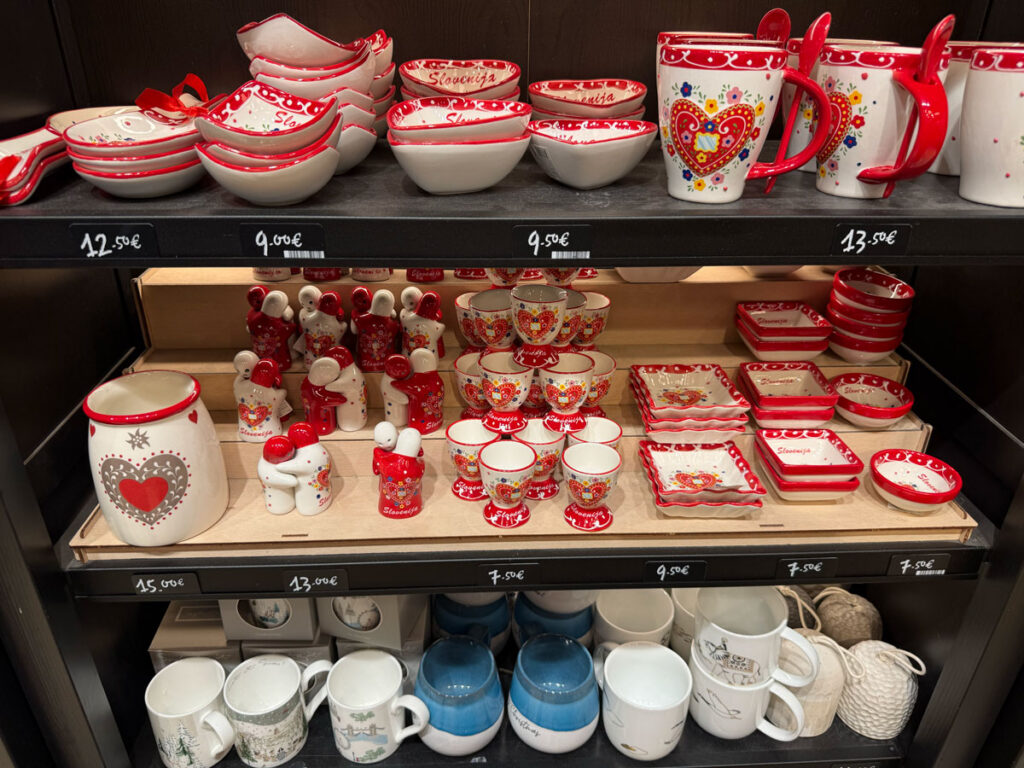
The red-and-white heart pattern shows up constantly on Ljubljana’s ceramics, and it’s the same folk-heart lineage as the gingerbread tradition, just moved onto mugs, bowls, and small hugging-couple figurines. Prices were reasonable across the board: small bowls from 7.50–9.50 EUR, mugs around 13.50 EUR, and a larger pitcher at 15 EUR. It’s a less history-dense buy than the salt or the honey, but it’s the kind of thing that’ll actually get used at home instead of sitting in a drawer.
Building a full Slovenia trip around this?
If Ljubljana souvenir shopping is part of a longer Slovenia itinerary, it’s worth locking in flights and a place to stay before prices climb. Get Up to 20% off with a Getaway Deal at Booking.com, which is worth checking before you commit to a hotel.
Tips to Save Money
- Compare prices across a few old town shops before buying. The same Piran salt and honey products show up at multiple shops, and prices can vary slightly street to street.
- The Central Market is worth a look before the tourist-strip souvenir shops. Local producers sometimes sell honey and salt directly at better prices than the packaged gift-shop versions.
- Buy chocolate and honey toward the end of your trip so it isn’t sitting in a hot bag for days before you get it home.
- Small linen pouches of salt or single honey jars make better small gifts than the boxed sets if you’re buying for a long list of people — the per-unit cost drops noticeably.
- Skip anything without a shop name or origin printed on it. Most of what’s genuinely Slovenian is clearly labeled — Piranske Soline, Carniola, FerMedica — and that labeling is a decent proxy for quality.
Quick Price Recap
| Souvenir | Price Range |
|---|---|
| Piran sea salt (pouch to gift set) | 6.50–27.90 EUR |
| Slovenian honey | 2.50–17 EUR |
| Honey liqueur | from 16 EUR |
| Beeswax candles (set of 3) | 8 EUR |
| Carniola landmark chocolate | 10 EUR per bar |
| Wooden marquetry art | 13.50–21.90 EUR |
| Folk-pattern ceramics | 7.50–15 EUR |
I went in expecting to spend money on things I’d forget I owned within a month. Instead, most of what came home with me — the salt, the honey, the little wooden dragon — is tied to something Slovenia has actually been doing, carefully, for a very long time. That’s a rarer thing to find in souvenir shopping than it should be, and it’s a big part of why Ljubljana is worth slowing down for.