
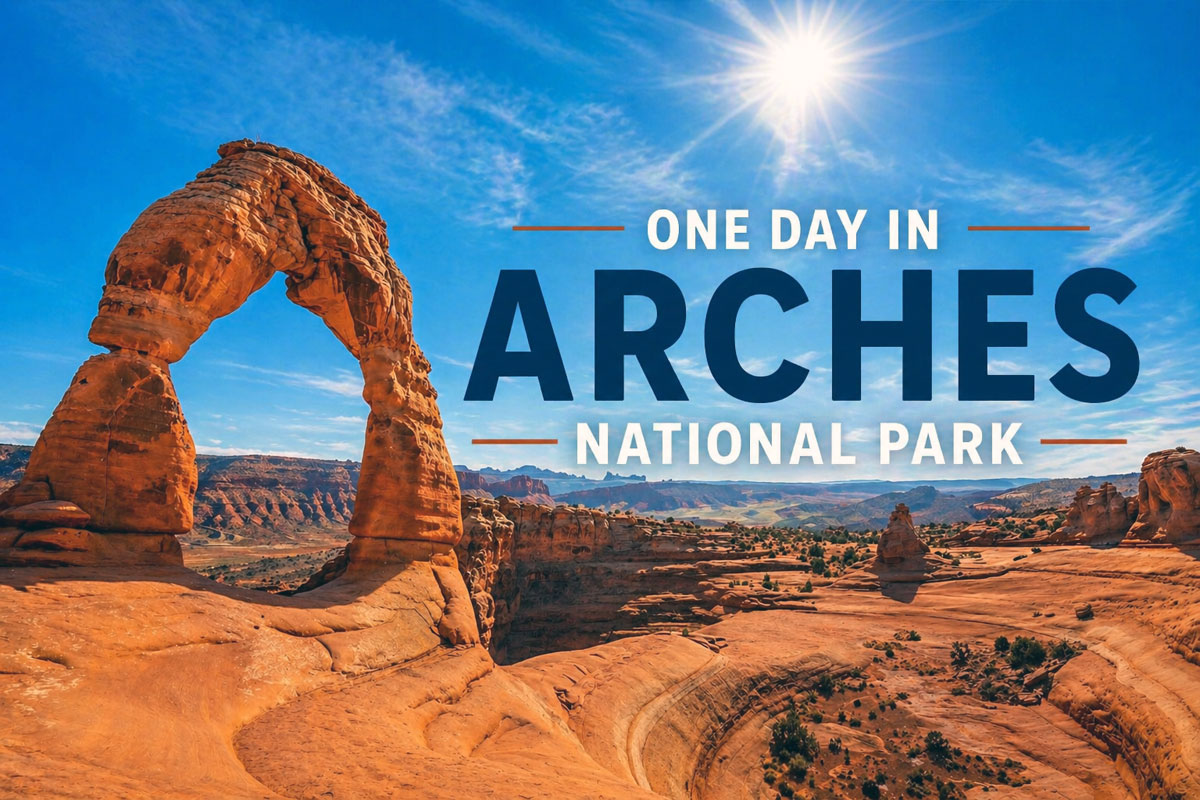
There’s a moment on the trail to Delicate Arch — somewhere around the second mile, when the slickrock opens up and the red desert spreads out in every direction — where most first-time visitors go quiet. Not from exhaustion, but from the simple fact that nothing they’ve seen before looks quite like this. Massive stone arches suspended impossibly in the air. Fins of salmon-colored sandstone rising like walls. A landscape that looks like it was designed by someone who had never seen the laws of physics.
Arches National Park is one of those places that earns its reputation completely. And the great news for first-time visitors: you don’t need a week to feel like you’ve truly been there. One well-planned day — the right stops, the right timing, an early start — gives you the full experience. Sunrise at Delicate Arch. The Windows Section in mid-morning. Devil’s Garden in the afternoon. A sunset that turns the red rock to fire.
This guide walks you through exactly how to do it: a complete hour-by-hour itinerary, every trail explained, entrance fees and timed entry demystified, where to stay in Moab the night before, and the practical tips that separate a great day from a chaotic one.
- Park location: Just north of Moab, Utah, off US-191
- Entrance fee: $30 per vehicle (7-day pass)
- Timed entry 2026: NOT required — no timed entry system in place for 2026
- Best time to arrive: Before 7:30 AM to beat crowds and heat
- Must-do hike: Delicate Arch (3 miles round trip, 2–3 hours)
- Best easy stop: The Windows Section (1 mile, 30–60 minutes)
- Closest airport: Salt Lake City (4 hours) or Grand Junction, CO (1 hour)
- Nearest town: Moab, Utah — 5 miles from the park entrance
Before You Go: What Every First-Timer Needs to Know
Timed Entry in 2026
This is the most important update for 2026: Arches National Park will NOT have a timed-entry reservation system in 2026. After several years of running a timed-entry program to manage surging crowds (visitation hit 1.8 million in 2021, with cars regularly being turned away at the entrance), the park has paused the requirement for 2026.
That said, the park still gets very crowded, particularly during spring and fall peak season. The main parking lots — especially at Delicate Arch and Devil’s Garden — can fill by mid-morning on busy weekends. The most reliable strategy remains the same: arrive early, before 7:30 AM if possible.
The park can reach its capacity limits by 7:30 AM, and the National Park Service will limit visitors entering for 3–5 hours when it does. An early start lets you avoid this entirely.
Entrance Fees
Here’s exactly what it costs to get in:
- Private vehicle: $30 (valid for 7 consecutive days, covers everyone in the car)
- Motorcycle: $25 (valid 7 days)
- Individual (on foot or bike): $15 per person
- Southeast Utah Parks Pass: $55 (covers Arches, Canyonlands, and Natural Bridges for the purchase month)
- America the Beautiful Annual Pass: $80 (covers all federal fee areas for one year)
If you’re visiting Arches as part of a broader Utah road trip — hitting Canyonlands, Bryce Canyon, Zion, or Capitol Reef — the America the Beautiful annual pass for $80 is one of the best deals in American travel. It covers the entry fee at every national park in the country for a full year. For families making even two or three park visits, it pays for itself immediately.
The pass is available digitally through Recreation.gov (instant, saves to your phone), or at the park entrance. If you order online through the USGS store, allow up to three weeks — go digital instead.
Read more: 7 Unique Spring Break Destinations for Family Fun
What’s Inside the Park (And What Isn’t)
Unlike Yellowstone or Zion, Arches is a relatively simple park to navigate. There is one main road — the Arches Scenic Drive — that runs 18 miles from the visitor center to Devil’s Garden at the end. All the major trailheads and viewpoints branch off this road.
There are no restaurants inside Arches National Park. Pack your lunch, snacks, and a lot of water before you enter. City Market in Moab is a full grocery store — stop there the morning of your visit for sandwiches, snacks, and drinks. There is no food available in the park, so stocking up in Moab beforehand means you don’t waste precious park time driving back for lunch.
Water refill stations exist at two locations only: the visitor center restrooms and near the Devil’s Garden Campground at the end of the main road.
Toilets are available at three trailheads: Devil’s Garden, Delicate Arch, and the Windows Section.
The Perfect One-Day Itinerary in Arches National Park
6:00 AM — Arrive at Devil’s Garden First (Before Anyone Else)
Here’s the counterintuitive move that separates a great Arches day from a frustrating one: drive all the way to the end of the park — to Devil’s Garden — first, before the parking lot fills.
Devil’s Garden is 18 miles from the entrance and is the most popular trailhead in the park. Its parking lot is also the first to fill, often by 9 AM on busy days. By driving straight there when you enter, you guarantee a spot and get the trail virtually to yourself.
Devil’s Garden is my favorite hike in the whole park. The out-and-back version is 7.9 miles total with all the spurs, but you can absolutely do a shorter version. The trail has the highest concentration of arches in the park — adventure vibes, rock formations, and genuinely spectacular desert scenery.
Trail options:
- Landscape Arch only (out-and-back): 1.6 miles, about 1 hour — the easiest option and still remarkable. Landscape Arch spans 306 feet, making it one of the longest natural arches on Earth.
- Landscape Arch + Double O Arch (out-and-back on the western loop): 4.5 miles, 2.5–3 hours — this is the recommended option for first-timers who want the best scenery without the full loop.
- Full Devil’s Garden Loop: 7.8 miles, 3–4 hours — for fit hikers who want the complete experience.
Along the way, spur trails lead to Tunnel Arch, Pine Tree Arch, Partition Arch, and Navajo Arch. The spur to Partition Arch is particularly worth it for the views through the arch back toward the main valley.
Pro tip: Sand Dune Arch is a short 0.4-mile round-trip detour near the Devil’s Garden trailhead — it’s sheltered in a slot canyon and is one of the most unique and photogenic spots in the park. Easy to add before or after your main Devil’s Garden hike.
Also nearby: Fiery Furnace Viewpoint, Salt Valley Overlook, and Panorama Point are all drive-up stops along the road near Devil’s Garden and worth a few minutes each.
Read more: 10 Sneaky Tricks to Take Stunning Travel Photos with Your Phone (No Fancy Gear Needed)
9:30 AM — Balanced Rock Hike
On your way back down the main road toward the entrance, stop at Balanced Rock — a 3,600-ton boulder perched on a narrow pedestal of eroded sandstone. You can see it clearly from the car, but it takes just 15–20 minutes to do the short 0.3-mile loop around the base. Up close, it’s genuinely disorienting in the best possible way.
Balanced Rock is one of the most-photographed formations in the park and one of the most accessible — essential for first-timers.
10:00 AM — The Windows Section
A short drive past Balanced Rock brings you to one of the park’s most rewarding areas: the Windows Section. Plan at least 60–90 minutes here to explore both the main area and Double Arch.
Windows Loop (1 mile, 30–60 minutes): The trail leads to North Window, Turret Arch, and South Window — three massive arches in close proximity that can all be explored on a single loop. The arches are enormous up close, framing desert and sky in ways that photos don’t fully capture.
Insider tip: After the South Window, follow signs for the Primitive Trail. The name will scare most casual visitors away — it generally deserves no such fear — and the path, which leads around the back of the Windows for a unique perspective, is often nearly deserted. It eventually leads back to the parking lot.
Double Arch (0.6 miles, 15–30 minutes): From the same parking area, the Double Arch trailhead leads to one of the most distinctive features in the park — two arches closely positioned together that form a beautiful open amphitheater. It’s one of the most accessible wow-moments in Arches, easy enough for all ages and genuinely memorable.
Between Windows and Double Arch, you can see perhaps nine arches in the park’s most efficient stretch. Don’t rush it.
12:00 PM — Lunch Break in Moab (or Picnic at the Park)
Midday in Arches is the hottest and most crowded time, especially in summer. This is the smart window to exit the park, grab lunch in Moab, restock your water, and return in the early afternoon when temperatures start to ease and the light improves for photography.
Moab has a surprisingly strong food scene for its size. Moab Diner is a local institution — classic, no-frills comfort food, perfect after a morning of hiking. The Moab Brewery is a solid option for lunch with good food and local craft beer. For quick fuel, City Market’s deli counter or the food trucks downtown are the fastest options.
Alternatively, if you packed a lunch (which is strongly recommended), there are picnic areas throughout the park. The Garden of Eden Viewpoint offers a nice spot on the main road between Windows and Delicate Arch.
1:30 PM — Garden of Eden Viewpoint
On your return into the park heading toward Delicate Arch, pull over at Garden of Eden Viewpoint. The dramatic rock formations here resemble a petrified garden, with sandstone columns and balanced rocks clustered together in a way that feels surreal from above. It’s a quick stop — 10–15 minutes — but one of the best viewpoints accessible from the car
2:00 PM — Delicate Arch Viewpoints
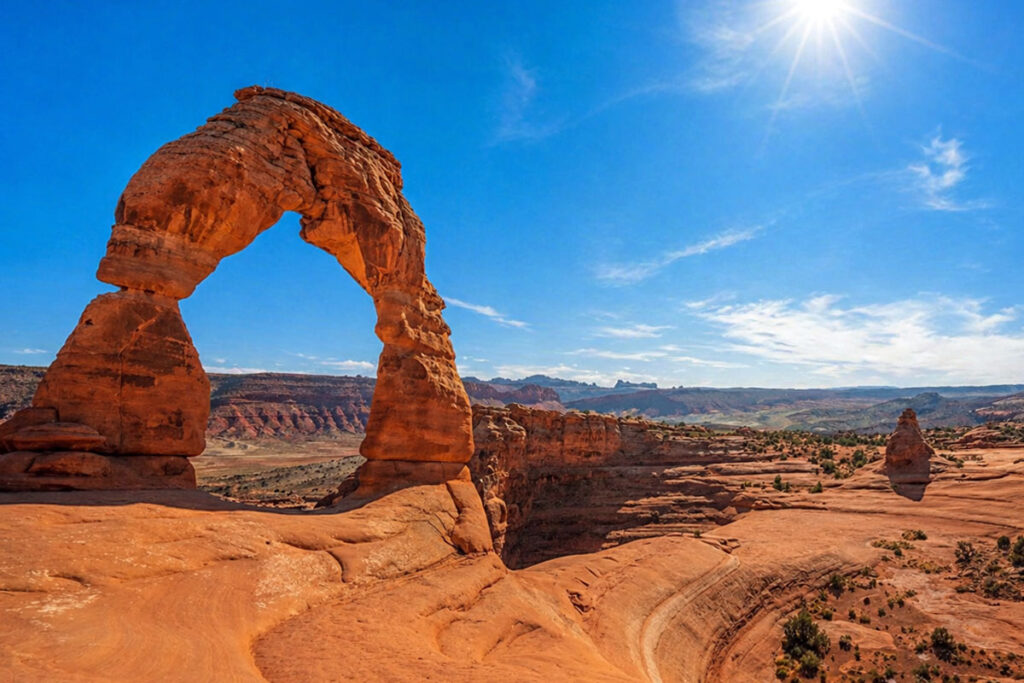
Delicate Arch is on Utah’s license plate. It’s the state’s most iconic natural landmark and arguably one of the most recognizable rock formations in the world. Seeing it from a distance is one thing. Standing underneath it is another thing entirely.
There are two viewpoints and one trail:
Lower Delicate Arch Viewpoint: Drive-up, essentially no walk. You can see the arch from a distance — worth a look even if you’re not hiking.
Upper Delicate Arch Viewpoint: A short walk (0.3 miles each way) to a better angle on the arch. Still a distant view, but a step up from the lower viewpoint.
Delicate Arch Trail (the real thing): 3 miles round trip, 480 feet elevation gain, 2–3 hours. This is the only way to actually stand beneath Delicate Arch. The hike is moderately strenuous — there’s a long stretch of open slickrock with no shade — but it’s not technically difficult. Most people of average fitness can do it.
The trail starts at Wolfe Ranch (where you’ll also find 150-year-old petroglyphs worth a few minutes), crosses a footbridge, then climbs steadily over open slickrock before rounding a corner to reveal the arch — 65 feet high, 46 feet wide, rising from the edge of a sandstone bowl with the La Sal Mountains in the distance.
That reveal moment is genuinely extraordinary. It’s one of those things that stops you mid-sentence.
Hiking to Delicate Arch is a must-do, since it is the only way to get up close to this arch. If you do only one hike today, this is the one.
Afternoon vs. sunset timing: The trail doesn’t offer much shade, making it harsh in the summer midday heat. The late afternoon — starting around 2–3 PM — gives you cooler temperatures and beautiful lighting as the sun moves toward the horizon. Sunset here is spectacular, with the arch glowing orange-red against a deepening sky.
5:30 PM — Sunset at Delicate Arch or the Windows
Two options for the final act of your day:
Option 1: Stay for sunset at Delicate Arch. If you timed your hike to arrive at the arch around 5–6 PM, you’ll be there for what many consider the best version of the view — golden hour light on red sandstone, the La Sal Mountains going purple in the distance, and a crowd of fellow visitors who’ve all made the same excellent decision.
Option 2: Return to the Windows for sunset. The Windows Section at golden hour is equally spectacular and offers slightly easier access for those who may have tired legs from the Delicate Arch hike. The arches frame the setting sun in a way that’s made for cameras.
8:00 PM — Moab for Dinner
Drive back into Moab and end the day properly. A few solid dinner options:
Moab Diner — the local institution, great for tired hikers who just want a real burger and a pie. The Broken Oar — solid American food, good location, reliable. Moab Brewery — great craft beer and filling food, perfect for a group.
If the sky is clear, the drive back into Moab along US-191 under the desert stars is worth slowing down for. Moab sits in one of America’s International Dark Sky Parks — the Milky Way on a clear night is genuinely extraordinary.
Where to Stay in Moab: Hotels for Every Budget
There are no hotels inside Arches National Park. Everything is in Moab, which sits 5 miles from the park entrance. All Moab hotels are within 10–20 minutes of the park entrance, so location differences between properties in town are relatively minor. What matters more is price, comfort, and whether the hotel has a pool — after a full day in the desert heat, a pool is a genuine luxury.
Luxury & Unique Stays
Hoodoo Moab, Curio Collection by Hilton
Price: from ~$139/night (KAYAK); peak spring rates ~$257/night | Rating:4.5 stars
This is the best traditional hotel in Moab — modern luxury that genuinely fits the desert setting without feeling out of place. Just a block from Main Street and minutes from Arches, the Hoodoo blends upscale amenities with Western style: a heated outdoor pool, Spa Moab (offering post-hike massages in a setting framed by red cliffs), and Josie Wyatt’s Restaurant and Bar serving steak and handcrafted cocktails. The 55-inch HDTV, mini-fridge, luxury bath products, and robes and slippers make it feel genuinely comfortable after a demanding day outdoors.
Guests consistently praise the views, the pool area, and the service. Several reviewers specifically mention it as their favorite anniversary hotel — the combination of natural beauty and genuine comfort is well-matched here.
Best for: Couples, anniversary trips, travelers who want the best traditional hotel experience in Moab.
Under Canvas Moab — Best Glamping in the West
Price: from ~$150/night for basic tents; $200–$350/night for Deluxe/Suite/Stargazer tents | Open: March 5 – October 26, 2026
Under Canvas Moab is something different. It’s a glamping resort — safari-style canvas tents on 40 acres of desert, seven miles north of Moab (and roughly three miles from Arches). The tents come with plush king-size beds, luxurious linens, en suite bathrooms (in Deluxe and above), wood-burning stoves, and private decks with lounge chairs.
The Stargazer Tent is the signature option: a viewing window above the bed lets you fall asleep watching the stars. The resort is one of the world’s first designated Dark Sky resorts, and nightly star parties, morning yoga classes, acoustic live music, and unlimited s’mores sessions are all included in the rate. The whole property runs on solar power.
Rates include activities like morning yoga classes, indoor and outdoor games, stargazing, and nightly s’mores sessions. Breakfast is not offered but grab-and-go snacks are available.
One honest note from reviews: the property sits near a busy highway, which some guests found noisy at night. Request a tent positioned away from the road when you book.
Best for: Couples, nature-focused travelers, anyone who wants an experience rather than just accommodation, photographers who want unobstructed stargazing.
Red Cliffs Lodge
Price: from ~$150/night | Rating: TripAdvisor Travelers’ Choice Award winner
Red Cliffs Lodge is the most scenic property in the Moab area — 2,000-foot red cliffs rising directly above, the Colorado River flowing past, and a location on Scenic Highway 128 about 15 miles from the park entrance. All 80 suites are freshly renovated and available for bookings, boasting modern amenities, sweeping scenic views.
The on-site activities include horseback riding, Colorado River rafting, and guided hiking in Arches and Canyonlands. The Ember Restaurant serves breakfast, lunch, and dinner with views of the river. It’s a working ranch atmosphere without the roughing-it aspects — genuine comfort in a genuinely spectacular setting.
Best for: Travelers who want the most dramatic natural setting rather than walkability to downtown, couples, photographers, those who want access to Colorado River activities.
Mid-Range: Best Value Options
Best Western Plus Canyonlands Inn
Price: from ~$211/night (KAYAK) | Rating: 9.1/10
One of the most consistently rated hotels in Moab — the combination of location (right in downtown Moab), clean and comfortable rooms, outdoor pool, fitness center, and reliable service puts it at the top of the mid-range list. Walking distance to restaurants and shops, and 10–15 minutes to Arches.
Fairfield Inn & Suites by Marriott Moab
Price: from ~$150/night | Rating: Consistently high
Named by many travel guides as the best hotel closest to the Arches National Park entrance. The Marriott flags deliver consistent quality — clean rooms, free breakfast options, pool, and reliable Marriott Bonvoy points for frequent travelers. A strong choice for families.
Homewood Suites by Hilton Moab
Price: from ~$188/night | Rating: 8.9/10
The indoor pool is the standout here — on a hot summer day or cool spring evening, it’s a significant advantage over outdoor-only pools. Apartment-style rooms with kitchenettes work particularly well for families or longer stays.
Holiday Inn Express & Suites Moab
Price: from ~$120/night | Rating: Consistently rated 8+
The complimentary Express Start Breakfast — with pancakes, signature cinnamon rolls, and hot options — is a genuine convenience for early-rising park visitors. Located on Hwy-191, just minutes from Arches and Canyonlands. A reliable, efficient choice with the IHG rewards program.
Comfort Suites Moab Near Arches National Park
Price: from ~$100/night | Rating: 4/5 TripAdvisor (ranked #13 of 47 Moab hotels)
One of the better value-for-money hotels in Moab. Free breakfast buffet, pool, spacious rooms with refrigerators, free WiFi, and a location within easy reach of both parks. Recent guests note the rooms are very spacious and clean, and the breakfast buffet has an impressive selection.
Read more: Expedia vs Booking.com: Which Travel Site Deserves Your Trust?
Budget Stays
Aarchway Inn Price: from ~$90/night | Great value for families — rooms accommodate up to 6 people, pool included, and the location directly on Highway 191 puts it closest to the park entrance of any budget option in Moab.
Moab Budget Options (under $100/night): Moab has several clean, functional budget motels along Main Street and Highway 191 that serve the basic needs of park visitors well — bed, parking, pool, short drive to Arches. The Rustic Inn, Bowen Motel, and Inca Inn are all consistently reviewed as clean and honestly priced.
Devil’s Garden Campground (inside the park): For campers, this is the only in-park option — 51 sites at the end of the main road, adjacent to the Devil’s Garden trailhead. Sites cost $25/night and are reservation-only through Recreation.gov. Booking 6 months in advance is essentially required for peak spring and fall dates. The payoff: waking up and walking directly onto the best trail in the park.
Essential Tips for Your One Day in Arches
Arrive before 7:30 AM. The park can reach capacity early on busy days, with the NPS limiting entry for 3–5 hours when it does. An early start beats the heat, beats the crowds, and gets you into the best parking spots.
Drive to Devil’s Garden first. It’s counterintuitive — most people start at the entrance end — but the Devil’s Garden parking lot fills earliest. Starting at the end of the road guarantees your spot at the most popular trailhead.
Bring way more water than you think you need. A minimum of 2–3 liters per person for a day of hiking in warm weather. The desert air is extremely dry, and dehydration can happen fast. The only water refill stations are at the visitor center and Devil’s Garden Campground.
Pack your own food. There is nothing to eat inside the park. Snacks, sandwiches, and trail mix packed in Moab before you enter are essential. Don’t plan to drive back into town for lunch unless you’re visiting in summer and need a midday heat break.
Wear sun protection. Most trails in Arches have zero shade. Sunscreen, a wide-brim hat, and UV-blocking clothing make a meaningful difference, especially in summer and spring.
Photograph at sunrise and sunset. The red sandstone turns extraordinary shades of orange, gold, and crimson in low light. Midday light is flat and harsh. The best photos in Arches happen in the first and last two hours of daylight.
The America the Beautiful Pass is worth it if you’re doing multiple parks. At $80 for a year’s access to every national park in the country, it pays for itself after three park visits. For anyone doing a Utah Mighty 5 road trip (Arches, Canyonlands, Bryce Canyon, Zion, Capitol Reef), it’s essentially mandatory.
Download offline maps before you enter. Cell service is unreliable inside the park. The NPS app includes offline maps of Arches, and apps like AllTrails have downloadable trail maps. Have them ready before you enter — don’t rely on signal.
The Junior Ranger Program is genuinely worth it for families. Arches has a Junior Ranger program — pick up the booklet at the visitor center (or print it at home before you go), complete the activities during your visit, and kids receive a badge sworn in by a park ranger. It gives kids a framework for the day and is consistently a highlight for families.
Read more: How to Find Cheap Flights on Expedia (2026 Guide)
Is one day enough to see Arches National Park? Yes — absolutely. One day is enough to see the park’s most iconic features and do 2–3 meaningful hikes. You won’t see every arch (there are over 2,000 documented), but you’ll see the best of what the park has to offer. Two days gives you more time and flexibility, but one day is a genuinely complete visit if you plan it well.
How hard are the hikes in Arches? Most are moderate and accessible to most visitors. Delicate Arch (the must-do) is 3 miles round trip with 480 feet of elevation gain on open slickrock — comparable to a brisk stair climb at home. The Windows Section is easy. Landscape Arch at Devil’s Garden is easy. The full Devil’s Garden loop (7.8 miles) is more strenuous. You don’t need to be an experienced hiker to have a great day at Arches.
Is Arches good for families with kids? Yes — it’s one of the most family-friendly national parks in the US. Most trails are short, the formations are dramatic enough to hold kids’ attention, and many of the best experiences (Balanced Rock, the Windows, viewpoints along the main road) require minimal physical effort. The Junior Ranger Program gives kids a structured way to engage with the park.
What is the best time of year to visit Arches National Park? Spring (March–May) and fall (September–November) are the best seasons — temperatures are mild, days are long enough for full itineraries, and wildflowers bloom in spring. Summer is very hot (temperatures above 100°F are common) but manageable with early/late day planning. Winter offers empty trails and beautiful snow-dusted rock formations, but shorter days and potential icy conditions on some trails.
Do I need a 4WD or special vehicle? No. The main scenic drive is fully paved and accessible to any vehicle. The major trailheads — Delicate Arch, Windows, Devil’s Garden, Balanced Rock — all have paved parking lots. A standard rental car is completely adequate for this itinerary.
Read more: How to Prepare Your Car for Summer Travel Without Stress
Is there cell service in Arches? Minimal to none inside the park. Download offline maps, trail guides, and the NPS app before you enter. Tell someone your itinerary. Don’t rely on GPS inside the park.
How far is Arches from Salt Lake City? About 230 miles, approximately 3.5–4 hours by car via I-70 and US-191. It’s a common one-way drive for visitors flying into SLC. Grand Junction, Colorado (the nearest regional airport, Canyonlands Field CNY) is about 1 hour away.
Arches National Park is not a place that reveals itself gradually. It announces itself immediately — the moment you crest the first rise after the entrance station and the landscape opens into something that looks borrowed from another planet. Red arches against blue sky. Fins of sandstone that glow pink at dawn. Shadows that move across the rock in ways that change the whole composition every hour.
What makes Arches unique among America’s national parks is that it rewards every type of visitor. The dedicated hiker can spend a full day on Devil’s Garden’s trails and still want more. The casual visitor can see five arches in two hours without straining. Families with young children find trails that are short, flat, and genuinely spectacular. Photographers have more golden-hour material than they can process in a lifetime.
One day, planned well, gives you all of it: the quiet of early morning on the trail, the satisfaction of standing beneath Delicate Arch, the deep-gold light of a desert sunset, and the long drive back to Moab under a sky full of stars.
Utah’s Mighty 5 national parks collectively represent some of the most extraordinary landscapes on earth. Arches is where most people start. It tends to be where they also decide to come back.
Book your hotel in Moab, pack your water and your sunscreen, set your alarm for 5:30 AM, and go.