

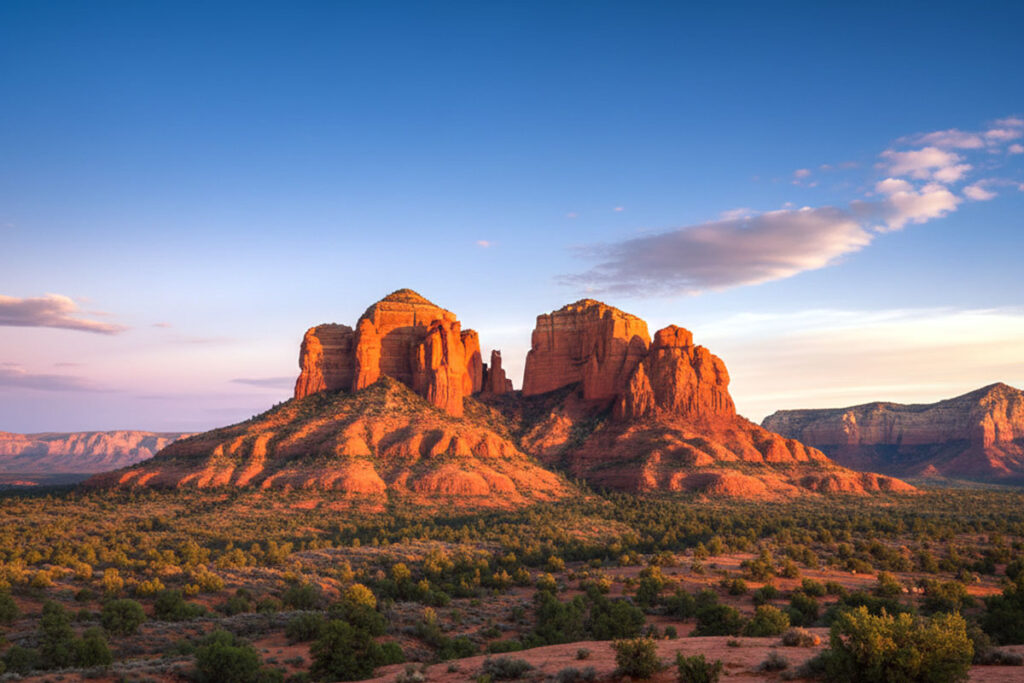
You don’t fully understand what people mean when they say Sedona is different until you’re standing at the trailhead watching the first light hit Cathedral Rock. The sandstone goes from deep burgundy to a color that doesn’t quite have a name — somewhere between gold and fire — and for a few minutes, everything else stops mattering.
Sedona is one of those American destinations that earns its hype. Not because it’s pretty — plenty of places are pretty — but because it layers things in a way most towns can’t. The outdoor adventures are genuinely world-class. The spa culture rivals anything in Scottsdale or Napa. The restaurant scene punches way above the town’s 10,000-person population, and the art galleries aren’t an afterthought. There’s a spiritual dimension here that some visitors seek deliberately and others stumble into completely by accident.
Located in north-central Arizona at 4,350 feet elevation — about two hours north of Phoenix, thirty minutes south of Flagstaff — Sedona pulls in 3–4 million visitors a year. The red rock landscape was shaped over 300 million years from the Schnebly Hill Formation, with iron oxide giving the stone its signature crimson hue. Artists discovered it in the 1940s, when surrealist Max Ernst settled here and the Sedona Arts Center took root. Filmmakers used the formations as the backdrop for westerns and blockbusters. The landscape hasn’t changed, but the town has gotten very good at serving the people who come to see it.
Here’s what’s worth knowing before the drive north.
- Best seasons: March–May and September–November
- Ideal trip length: 3–4 days
- Most famous hike: Devil’s Bridge
- Best sunrise hike: Cathedral Rock
- Top luxury resort: Enchantment Resort (from ~$319/night, but check renovation dates)
- Best mid-range pick: Amara Resort & Spa or Arabella Hotel Sedona
- Best budget base: Courtyard by Marriott Sedona or GreenTree Inn
- Nearest major airport: Phoenix Sky Harbor (PHX), 2 hours south
- Red Rock Pass: Required at most trailheads — $5/day, $15/week, $20/year
What Makes Sedona Worth the Trip
Most destinations have one selling point. Sedona has five or six working simultaneously.
The hiking is as serious as anything in the Southwest — challenging climbs with real elevation, technical terrain, canyon scrambles that earn their payoff. The wellness and spa scene is among the best in the country, built around the energy vortex sites that draw seekers from every background. The Verde Valley wine region, twenty minutes from downtown, is a genuinely underrated American wine country producing bold reds and crisp whites at a fraction of what you’d pay in Napa, without the crowds.
And then there’s the scenery. The buttes, mesas, and arches change color throughout the day — hitting their most spectacular in the first and last hours of daylight, going full fire at golden hour. Every season delivers something different. Spring brings cactus flowers blooming across the desert floor. Winter occasionally dusts the red rock with snow for landscape photographs that look almost unreal. Fall turns the cottonwoods gold along Oak Creek while temperatures stay perfect for hiking.
It’s a place that rewards repeat visits in a way that few destinations do. Residents who’ve lived here for twenty years describe the red rock formations as something they never stop noticing.
What to Do in Sedona
Cathedral Rock at Sunrise — Start Here
If there’s a single image that defines Sedona, it’s Cathedral Rock — the 4,965-foot sandstone butte that appears on postcards, license plates, and the cover of every Arizona travel magazine ever printed. Seeing it from the road is one thing. Hiking it at sunrise is a different category of experience entirely.
The trail is short — 1.2 miles — but gains 741 feet, and the upper section involves scrambling over exposed rock that gets your attention. Get there early. The parking lot fills fast, the crowds build quickly after 8 AM, and the light in the first twenty minutes of daylight on those upper ridges is extraordinary in a way that midday hiking simply doesn’t deliver.
Red Rock Crossing, just below Cathedral Rock along Oak Creek, is where the butte reflects in the water. It’s one of the most photographed spots in Arizona, and the walk from the parking area is minimal. Sunrise and sunset there both produce images that are difficult to mess up with any camera.
Devil’s Bridge — The Most Popular Trail in Sedona
A 1.8-mile hike leads to Sedona’s iconic natural sandstone arch — one of the largest natural arches in the area — with views of the surrounding valley that genuinely stop people mid-sentence on the way up. Standing on the arch itself, with the desert spread out in every direction, is the kind of moment that makes people book return trips.
The honesty piece: it gets extremely crowded on weekends. The parking lot on Dry Creek Road fills before 8 AM on busy spring Saturdays. Going on a Tuesday or Wednesday morning, or arriving well before 7 AM on weekends, dramatically improves the experience. The free Verde Lynx shuttle — running Thursday through Sunday, 7 AM–5:30 PM — drops riders at the trailhead and saves the parking battle entirely on those days.
Devil’s Bridge is worth doing, but it’s not the most rewarding hike on this list. Cathedral Rock and Bear Mountain both deliver more for hikers who can handle more elevation.
Bear Mountain — The One That Earns It
Bear Mountain Trail runs 4.9 miles with 2,024 feet of elevation gain, steep nearly the entire way up. It’s the hardest hike most visitors to Sedona will attempt, and the payoff at the summit — 360-degree views taking in the entire red rock landscape in every direction — is one of the great hike endings in the American Southwest.
Not a hot-weather hike. Not a hike to attempt without 3 liters of water per person. Start before 7 AM in spring and fall, earlier in summer. The summit on a clear weekday morning, when the trail is nearly empty and the views are unobstructed, is the version of Sedona that people who’ve been here ten times are still talking about.
Boynton Canyon Trail — Sedona’s Most Complete Hike
Six miles, moderate, with panoramic views appearing early and staying for most of the route. Red buttes, pine forests, canyon walls, optional stops at ancient Sinagua ruins and a hidden cave. One of four main vortex sites.
The Boynton Canyon trail runs directly through the Enchantment Resort property and is accessible from the main trailhead at the canyon entrance. It’s the most well-rounded experience in Sedona — diverse terrain, genuine canyon depth, historical stops, and the kind of quiet that’s hard to find on more trafficked trails.
Airport Mesa at Sunset — Don’t Skip This
There are better-kept secrets in Sedona than Airport Mesa at sunset, but none that deliver a more reliable wow moment with less effort. The viewpoint sits on top of the mesa where Sedona’s small airport operates, giving an unobstructed 270-degree panorama of the red rock formations surrounding the town. At sunset, the buttes move through a sequence — burnt orange, deep red, purple, violet — that draws a crowd of photographers and visitors every single evening.
It’s free. It’s accessible. And it’s one of those experiences where you stand next to a complete stranger and both go quiet at the same time.
For those who want more than a viewpoint pull-off, the Airport Mesa loop hike is 3.2 miles with views for essentially the entire circumference. A solid option for an evening walk with cocktail-hour light.
One quieter alternative: the upper section of Girdner Trail, at the end of Cultural Park Place, offers a good panorama of the same nightly sky fire with significantly fewer people.
West Fork of Oak Creek Canyon — Cool, Shaded, Unlike Everything Else
The stretch of State Route 89A that winds through Oak Creek Canyon is one of America’s most scenic drives — dramatic red rock formations on both sides, Slide Rock State Park in the middle, and the West Fork trailhead about fourteen miles from Sedona. The West Fork Trail follows a creek at the bottom of a 1,000-foot canyon through a series of creek crossings (wet feet are guaranteed) into a slot canyon with towering walls and lush riparian growth.
It’s unlike anything else in Sedona. Cool where the red rock trails are hot, shaded where the butte hikes are exposed, and peaceful in a way that requires no spiritual framing to appreciate. Plan two to four hours depending on how far in you go. The crowds thin significantly past the first mile.
Jeep Tours — More Legitimate Than They Sound
Sedona’s jeep tour industry draws eye-rolls from people who haven’t done one, and converts nearly everyone who has. The terrain accessible only by 4WD vehicles is genuinely different — steeper, more remote, with formations and overlooks that trail hikers never reach.
Pink Jeep Tours’ Broken Arrow route is the most popular, through red rock terrain to the Chicken Point overlook. Arizona Safari Jeep Tours runs an Archaeology tour ($135–175/person, 3 hours) that includes exclusive access to private land with ancient Sinagua ruins and petroglyph sites — a different category of experience than pure scenic touring. The Vortex tour ($109–145/person, 2.5 hours) visits Airport Mesa, Amitabha Peace Park, and Rachel’s Knoll with guides who provide both geological context and cultural history.
Standard 2-hour tours run $89–136 per person. Book ahead on spring and fall weekends — these sell out.
Energy Vortex Sites — Whether You Believe or Not
The four main vortex sites — Airport Mesa, Cathedral Rock, Bell Rock, and Boynton Canyon — are simultaneously Sedona’s most famous spiritual destinations and four of the most beautiful locations in the area. Whether you come for the metaphysical properties or just because they’re excellent hikes, the experience holds up either way.
Cathedral Rock vortex is considered an inward-focused site by local practitioners. Airport Mesa is an upflow vortex. Bell Rock draws people for both the spiritual energy and the extraordinary shape — a perfect bell form rising from the desert outside of town that’s accessible by an easy trail from Village of Oak Creek.
Guided vortex tours run 2–2.5 hours and cost $75–100 per person. The guides with deep local knowledge are the ones who make these worth paying for — they provide Native American history, settlement stories, and geological context that turns a hike into something layered.
Hot Air Balloon Rides — Go at Least Once
Sedona’s hot air balloon experience is genuinely exceptional. The landscape from above — red formations, canyon cuts, the thin line of Oak Creek threading through the valley — is a completely different perspective on terrain that feels big at ground level. Predawn departures mean watching the light shift from inside the basket.
Northern Light Balloons is the most consistently praised operator. Flights launch at sunrise, last 1–1.5 hours, and land with champagne and breakfast. Typical cost: $225–295 per person. Book at minimum two weeks ahead in spring — available dates disappear fast during peak season.
Verde Valley Wine Country — The Under-the-Radar Winner
The Verde Valley has emerged quietly as a serious wine region. Over 100 grape varieties planted across vineyards in Cornville, Page Springs, and Clarkdale — with elevation and dramatic temperature swings creating conditions for bold reds and crisp whites that regularly surprise people expecting Arizona wine to be mediocre.
Javelina Leap Winery, Page Springs Cellars, and Oak Creek Vineyards are the main stops. Guided wine tours from Sedona visit 3–4 tasting rooms for around $95 per person including transport, tastings, and often lunch. The drive through the valley to get there is worth doing for its own sake.
Most wineries are open daily for tastings. Weekends during spring and fall benefit from reservations. For visitors who want to drive themselves, the route from Sedona along SR-89A south through Cornville and toward Page Springs takes about 20 minutes and passes through terrain that has nothing to do with the red rock landscape — a worthwhile perspective shift for a half day.
Slide Rock State Park — A True Arizona Classic
Natural water slide, 43-acre working apple orchid, sandstone bluffs, rustic cabins from the 20th century. Slide Rock is one of Arizona’s most visited attractions, and the crowds in summer reflect that — the 80-foot natural slide draws visitors from across the state, and the parking lot fills well before noon on warm weekends.
Spring and fall deliver the same experience with a fraction of the crowds. Arrive early regardless of season. The swimming holes past the main slide area get progressively less crowded the farther upstream you go.
Tlaquepaque Arts & Shopping Village
Vine-covered stucco walls, winding walkways, cobblestoned courtyards filled with the sound of occasional flamenco performances — Tlaquepaque is the shopping experience in Sedona that justifies actually going into shops rather than just walking past them. The galleries here range from serious fine art to regional craft, and the architecture makes it pleasant even without a shopping agenda.
El Rincon Restaurante Mexicano sits inside the village and serves some of the better Mexican food in Sedona proper. The courtyard fountain is a legitimate place to sit with a coffee and not do anything in particular.
Where to Stay in Sedona
Sedona runs 50–80% more expensive than most Arizona destinations. Hotels range from $90–150/night for budget properties to $180–350 for mid-range, and $300–700+ for luxury resorts. The average across all categories hovers around $303/night in 2026. Here’s what actually delivers for the price.
Read more: 7 Unique Spring Break Destinations for Family Fun
Luxury
- Enchantment Resort
Location: Boynton Canyon | Price: from $319/night; average around $1,035; peak reaches $1,951 | Couples rating: 9.7/10
Nestled in 70 acres of high desert terrain in Boynton Canyon, Enchantment is the kind of resort where guests consistently run out of adjectives. Casitas with beehive fireplaces and private decks overlooking canyon walls. Four restaurants anchored by Che Ah Chi serving indigenous-influenced cuisine and the View 180 with a sommelier-curated wine list. Pools scattered throughout the property with canyon views from every angle. Hiking trails accessible directly from the resort. And the Mii Amo Spa — 24,000 square feet, named the number-one destination spa in the US by Travel + Leisure— offering Native American-inspired therapies, energy clearing, and outdoor treatments along Oak Creek.
Guests who’ve traveled extensively use phrases like “earth’s crown jewel” without irony. The canyon setting is physically remote from downtown Sedona — about 20 minutes — which works perfectly for people who want total immersion and frustrates those who want easy restaurant access.
One critical 2026 note: Enchantment is undergoing renovation from May 11 through October 31. Confirm what’s operational before booking for that window. Cheapest rates typically fall in January and July; Sundays and Thursdays run lower than weekends. Southwest residents from AZ, CA, CO, NV, NM, OK, and UT qualify for special resident rates — worth asking about directly.
- L’Auberge de Sedona
Location: Uptown Sedona, on Oak Creek | Price: typically $200+ above Enchantment; starting around $350/night
More intimate than Enchantment, more central, set at a lower elevation that isolates it from the noise and crowds of Uptown Sedona while keeping restaurants and galleries walkable. Creek-side cottages with mountain or water views. A full-service restaurant serving all three meals. Free shuttle service throughout the property.
The accommodations run consistently more updated than Enchantment’s and the location suits travelers who want a luxury base for exploring town as much as for retreating from it.
- Amara Resort & Spa
Location: Uptown Sedona, on Oak Creek | Price: from ~$463/night
Sleeker and more modern than the traditional Southwestern aesthetic of most Sedona properties. The infinity pool and hot tub framed by desert landscaping is genuinely one of the more beautiful pool setups in northern Arizona. The creek-side location along Oak Creek, the award-winning spa, and SaltRock Southwest Kitchen (regional seasonal menus that are actually good) make this a strong option for travelers who want design-forward spaces rather than Santa Fe-style décor.
Read more: One Day in Arches National Park
Mid-Range
- Arabella Hotel Sedona
Location: Uptown Sedona | Price: from ~$150/night | Rating: 9.2/10 on Expedia
One of the most consistently well-reviewed mid-range hotels in Sedona. Romantic atmosphere, excellent location for trail access, clean and genuinely comfortable rooms. Good value by Sedona standards.
- Sky Ranch Lodge
Location: Airport Mesa | Price: from ~$137/night
The location is the entire argument — sitting on top of Airport Mesa gives the Sky Ranch Lodge the same sunset panorama that makes the Airport Mesa viewpoint famous, but from a private balcony. It’s a simpler property without resort amenities, but if the plan is to watch the light change over the red rocks every evening, nowhere in Sedona puts you closer to that experience.
- Courtyard by Marriott Sedona
Location: West Sedona | Price: from ~$120/night
Reliable, clean, good parking, pool, Bonvoy points, and a location in West Sedona that puts major trailheads within 5–10 minutes. For travelers who spend most of the day outside anyway, it’s the right call.
Read more: 10 Sneaky Tricks to Take Stunning Travel Photos with Your Phone (No Fancy Gear Needed)
Budget
- GreenTree Inn Sedona
Location: West Sedona | Price: from ~$80–100/night
Free WiFi, outdoor pool, parking, EV charging, and a restaurant on-site. Straightforward and honest. Not luxury, but clean and well-positioned for trail access. Works fine for anyone treating the room as a place to sleep after a full day outdoors.
- Sedona Pines Resort
Location: West Sedona | Price: from ~$189/night
Standalone tiny-house style units with full kitchens, private porches, and reserved parking. Water features, free laundry, hot tub, and an Italian restaurant on the grounds. Particularly good value for longer stays or families who want the kitchen option.
Camping: Manzanita Campground on SR-89A is one of the most scenic campgrounds in Arizona. Book through Recreation.gov months in advance for spring and fall — sites go fast. Dispersed camping within Coconino National Forest is available with a Red Rock Pass.
Budget alternative: Cottonwood, 25 minutes southwest via Highway 89A, offers chain motels and hotels at $85–165/night year-round — 40–60% cheaper than comparable Sedona properties with a 25-minute drive to get into the red rocks. No views, no galleries, but the savings are real over a multi-night trip.
Where to Eat
Mariposa is Sedona’s most-booked restaurant — a Latin-inspired American grill with wood-fired meats and a terrace with red rock views that justify the effort of getting a reservation. Book weeks in advance for peak spring and fall weekends. It’s genuinely excellent, not just famous.
Elote Cafe is the other reservation-required anchor of Sedona dining — Mexican food elevated with serious technique, a focused menu, and a room that fills every night. Walk-ins are nearly impossible. Call ahead.
Hideaway House sits on a cliff edge overlooking Sedona with pizza, pasta, wine, and a view worth the narrow road up. One of those places where the setting and the food reinforce each other, and neither is a disappointment.
Coffee Pot Restaurant is the casual, locals-first diner in West Sedona — open early, reliably good, unpretentious, and exactly the right breakfast before a morning trail. The omelets are the menu item most people come back for.
Javelina Cantina serves solid casual Mexican on the main strip in Uptown with a large patio and margaritas that justify the wait. Crowded but manageable.
Oak Creek Brewery & Grill in West Sedona handles post-hike burgers, sandwiches, and craft beer in a relaxed setting that doesn’t require changing out of hiking clothes.
Spas deserve their own mention in any honest accounting of where to spend time in Sedona. Many spas use indigenous materials like red-rock clay and local plants — hot stone therapy, chakra work, and outdoor deep-tissue massages on the banks of Oak Creek are available at multiple properties. The Amara Spa’s Winds of Change treatment combines energy work with massage, guided meditation, crystals, and aromatherapy in a 90-minute session that reads as unusual on paper and tends to convert skeptics.
Read more: How to Prepare Your Car for Summer Travel Without Stress
Which Part of Sedona to Stay In
Uptown Sedona is the most walkable area — shops, galleries, restaurant row, and the departure point for most tours within easy reach on foot. Busier and noisier than anywhere else in town, but the convenience is genuine for first-timers who want to explore without a car on their first evening.
West Sedona is where locals actually live and where most of the more affordable hotels cluster. Quieter, less crowded, and positioned well for trail access — Airport Mesa, Boynton Canyon, and Thunder Mountain are all a short drive from here. The right choice for active travelers treating Sedona primarily as a hiking base.
Village of Oak Creek sits about six miles south of Uptown and provides the closest access to Bell Rock and Courthouse Butte — two of the best formations on the south side of town. A touch removed from the main restaurant scene, but prices run 10–20% lower than comparable Uptown properties. Good base for golfers (Sedona Golf Resort is here) and anyone who wants a quieter neighborhood.
When to Go
March through May is peak season for a reason — temperatures in the 60s and 70s, cactus flowers blooming across the desert floor, long days that give hikers time to do two trails in a day, and the most active version of the town’s restaurant and gallery scene. Book hotels 4–8 weeks out for this window, and restaurant reservations even further ahead for places like Mariposa and Elote.
September through November rivals spring for weather and delivers one of the more beautiful landscape transitions in Arizona — cottonwoods turning gold along Oak Creek while the red rock itself shifts warmer with the low fall sun. Thinner crowds than spring, still-excellent hiking conditions.
June through August brings heat into the 90s and monsoon storms in July and August that make afternoon hiking inadvisable. Trail temperatures before 9 AM are significantly more manageable than midday, and hotel prices drop noticeably — luxury rooms that run $400+ in spring sometimes appear at $250 in summer. The swimming holes at Slide Rock and along West Fork become the central daytime attraction.
December through February is the quietest and most affordable window. The January deals at Enchantment and L’Auberge are sometimes the lowest of the entire year. Occasional snow on the red rock formations creates landscape photographs that look almost impossible. Shorter days mean less hiking time, but the absence of spring crowds makes the trails feel completely different.
What Most People Get Wrong About Sedona
Weekdays versus weekends matter more here than almost anywhere else. The difference between a Tuesday at Cathedral Rock and a Saturday at Cathedral Rock is a different trip. Full parking lots, trail congestion that changes the experience of being outdoors, and restaurant waitlists that appear on peak weekends are not factors that mid-week visitors encounter. If the schedule allows any flexibility, shifting the trip to weekdays changes what Sedona actually feels like.
The Red Rock Pass catches people off guard — most trailheads require one, and enforced. $5 per day, $15 per week, $20 for the year. The annual pass is the obvious choice for any stay over three days or for anyone planning to return to Arizona.
Uber and Lyft exist in Sedona technically, but can be difficult to find and shouldn’t be the primary transportation plan. A rental car picked up at Phoenix Sky Harbor is the standard approach for good reason — without one, trailheads more than walking distance from Uptown require either a jeep tour or the limited Verde Lynx shuttle schedule.
Cottonwood as a base camp is worth considering seriously for anyone on a tighter budget. Twenty-five minutes from the red rocks, 40–60% cheaper on accommodation, same access to trails and wineries and the canyon. The only thing missing is waking up to the view — and for travelers who spend sunrise to sunset outside, that trade-off is straightforward.
The dining prices are high, and the resort fees at luxury properties add up fast. Sedona is genuinely one of Arizona’s most expensive destinations — accommodation rates run 50–80% above Phoenix or Tucson, restaurant prices 20–30% above state averages. Budget for it or it becomes unpleasant to keep track of.
Is Sedona worth visiting? Yes — clearly and unambiguously. The red rock landscape is one of the most visually dramatic in the United States, and the layering of good hiking with strong restaurants, real art, spa culture, and wine country makes it rare among American nature destinations. Even a three-day trip produces memories people return to for years.
How many days do you actually need? Three days covers the highlights without feeling rushed. Four days is the comfortable option that lets you add the Verde Canyon Railroad, wine country, or a day trip toward Flagstaff or the Grand Canyon without sacrificing any core Sedona experiences.
What’s the best hike for someone who hasn’t been here before? Cathedral Rock. It’s short enough to feel manageable, demanding enough to feel earned, and the view at the top delivers the full experience of why people make long drives to get here.
How far is Sedona from the Grand Canyon? About 110 miles from the South Rim — roughly two hours and fifteen minutes via US-89A north. It’s one of the most logical day trips in Arizona and several tour operators run full-day excursions from Sedona for visitors who don’t want to self-drive.
Is Sedona good for families? Yes. Bell Rock, Fay Canyon, and the easy walks around Courthouse Butte work well for mixed-age groups. Slide Rock State Park is a genuine all-ages hit. Jeep tours are popular with kids. Red Rock State Park runs a Junior Ranger program for younger visitors.
What exactly is a vortex? A site where local tradition holds that the Earth’s energy rises or spirals in ways that affect mood, energy, and spiritual state. The four main sites — Airport Mesa, Cathedral Rock, Bell Rock, Boynton Canyon — each carry different qualities according to local practitioners. The practical answer: regardless of what you believe about the metaphysical properties, all four sites are excellent hiking destinations with genuinely striking landscapes.
Sedona rewards planning more than almost any other destination its size. The visitors who show up on a spring Saturday without reservations — no hotel room, no restaurant booking, no trail plan — find crowded parking lots, sold-out balloon flights, and three-week waits at Mariposa. The visitors who plan a few things in advance — a hotel with actual views, an early morning on Cathedral Rock, a jeep tour for one morning, dinner at Elote — find the version of Sedona that people are describing when they say they can’t stop thinking about it.
The red rock at golden hour really does turn that particular shade of fire that photographs don’t capture accurately. The silence on Bear Mountain’s summit on a weekday morning is the kind of quiet worth driving four hours to find. The wine at Page Springs Cellars is better than expected. And the feeling of watching sunrise from the Chapel of the Holy Cross, set into a cliff face with the valley spread below, is one of the cleanest experiences of awe that this country offers.
Four hours from Las Vegas. Two hours from Phoenix. Thirty minutes from Flagstaff. It slots into a Southwest road trip or stands on its own. Either way, it’s one of the places in America that still justifies the drive.