
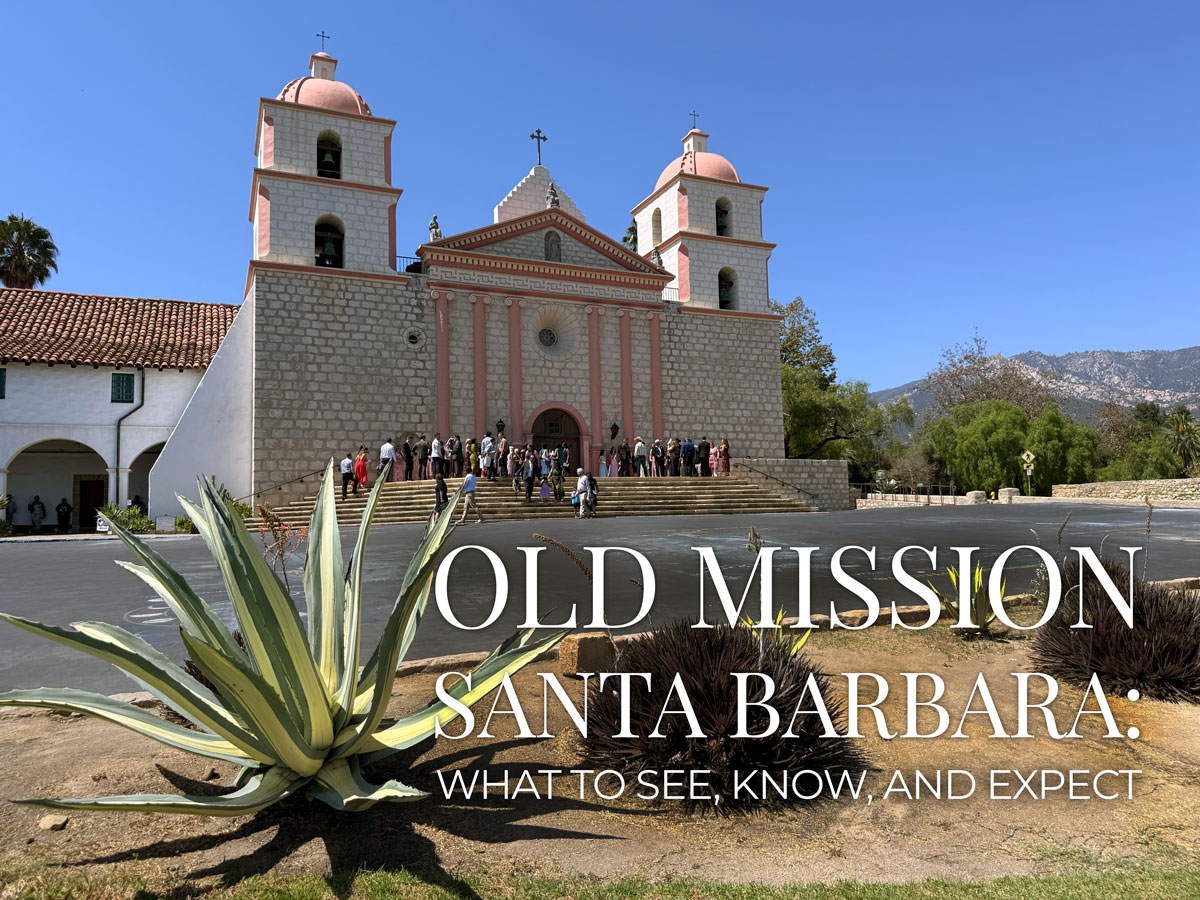
If you are planning a trip to Santa Barbara, Old Mission Santa Barbara is one of those places that is easy to recognize in photos but much more interesting once you walk through the gates. The white stucco buildings, terracotta roofs, palm trees, gardens, and mountain backdrop look almost too perfect to be real.
But the Mission is more than a pretty historic building.
Founded in 1786, Old Mission Santa Barbara is the tenth of California’s 21 Spanish missions and remains an active Franciscan and Catholic community. Today, the 15-acre site includes the Mission church, museum, historic cemetery and mausoleum, gardens, and other historic buildings.
So, is it worth visiting? Yes — especially if you enjoy history, architecture, gardens, photography, or places that give you a better understanding of Santa Barbara beyond its beaches and restaurants.
Old Mission Santa Barbara at a Glance
- Address: 2201 Laguna Street, Santa Barbara, CA 93105
- Founded: December 4, 1786, the tenth of California’s 21 Franciscan missions
- Current church built: 1820, after earlier adobe structures were destroyed by earthquakes
- Self-guided tour hours: Monday–Saturday 9:30 a.m.–5 p.m. (last ticket sold 4 p.m.); Sunday 12:30–5 p.m. (last ticket sold 4 p.m.)
- Admission: $17 adults (18–64), $15 seniors (65+) and active military, $12 youth (5–17), free ages 4 and under, $3 with SNAP EBT through Museums for All
- Good to know: The church and cemetery close periodically for weddings, funerals, and Masses — the rest of the tour stays open
A Brief, Honest History of the Mission
Mission Santa Barbara was founded on December 4, 1786 by Father Fermín Lasuén, the Franciscan who succeeded Junípero Serra as head of the California mission system. It was the tenth mission established along the coast, built to extend Spanish colonial control over Alta California and to convert the local Chumash people to Catholicism — a purpose the mission’s own museum addresses directly rather than glossing over.
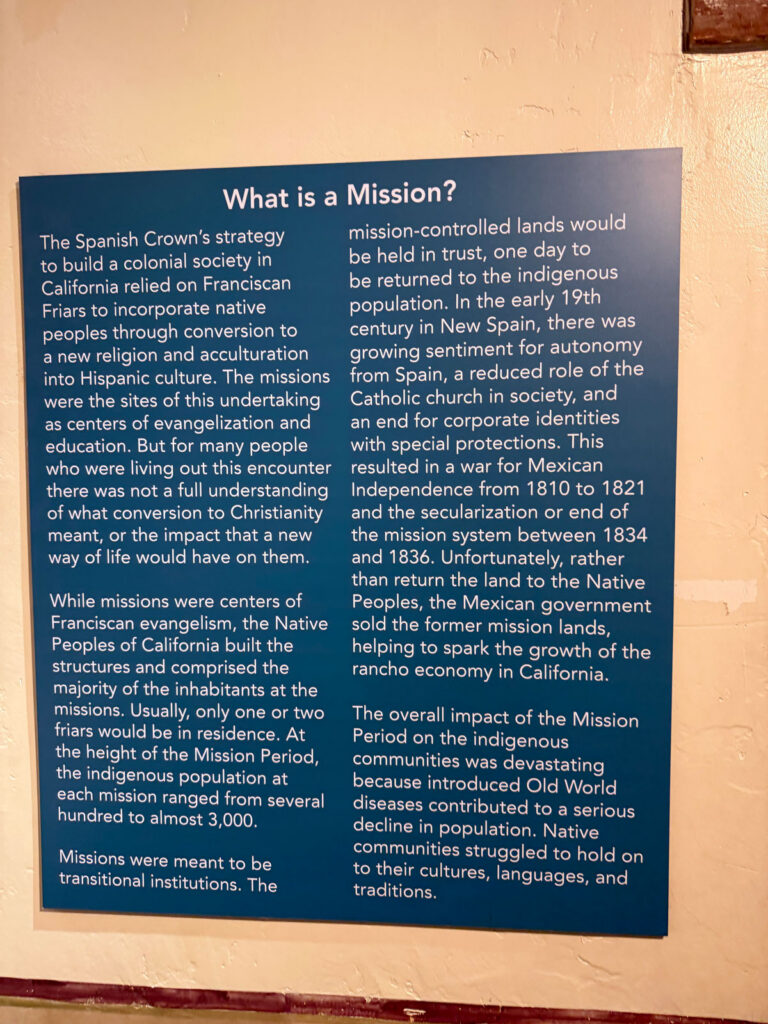
A wall panel inside the museum, titled simply “What is a Mission?”, lays out the arrangement plainly: missions were meant to be transitional institutions, with mission-controlled land eventually returned to the Indigenous population. That never happened. When Mexican independence led to the secularization of the mission system between 1834 and 1836, the land was sold off instead, feeding into California’s rancho economy rather than being returned to the Chumash. The same panel notes that introduced diseases during the mission period caused a serious decline in the Native population, even as native communities worked to hold onto their languages and traditions.
Read more: The Best Things to Do in Santa Barbara
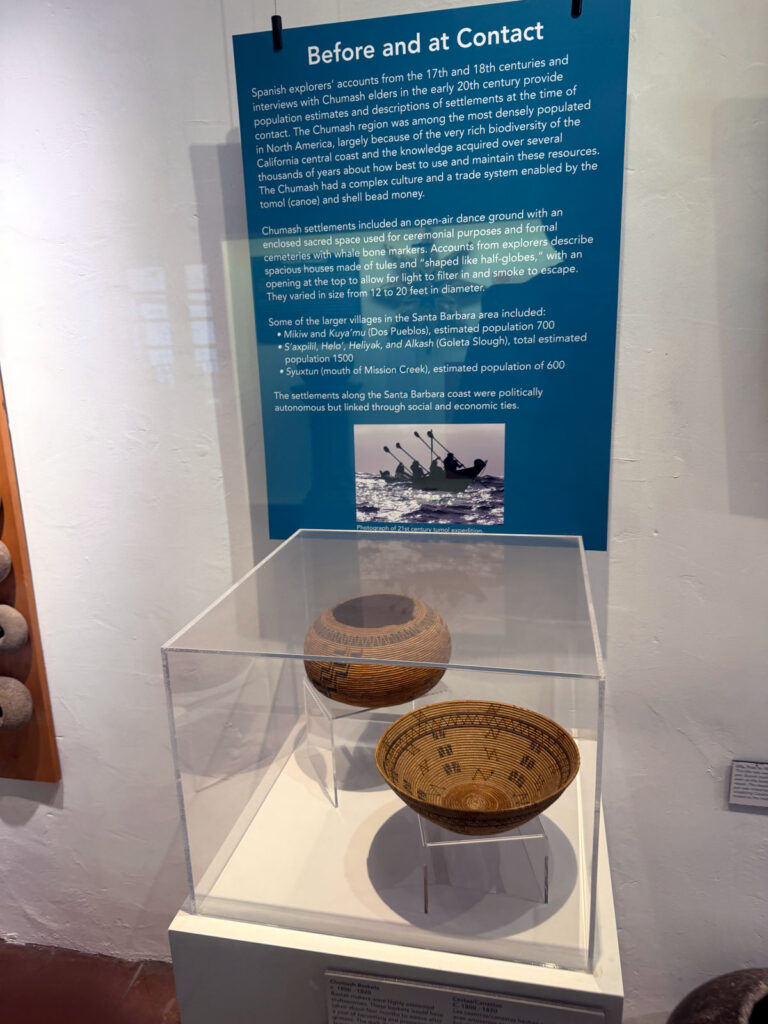
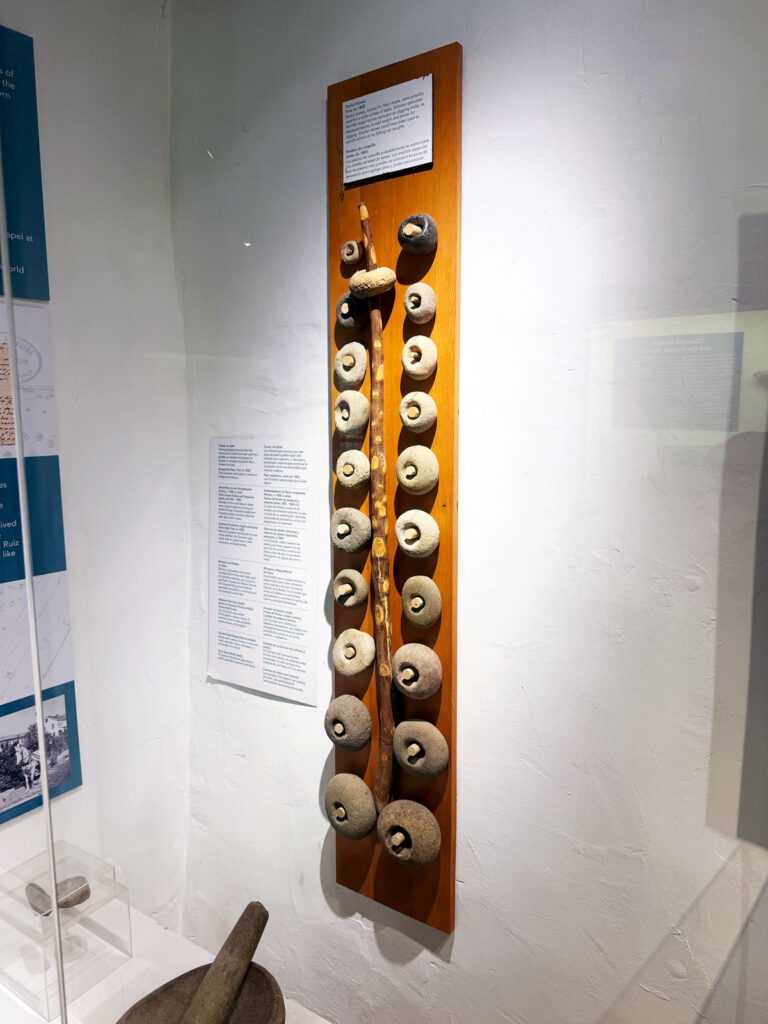
Chumash labor built essentially everything at the mission, from the church itself to its aqueduct and tanning vats, and Chumash artisans went on to shape much of its decorative and musical life — training as choristers, learning European instruments, and crafting ceremonial objects that blended their own traditions with the mission’s Catholic imagery.
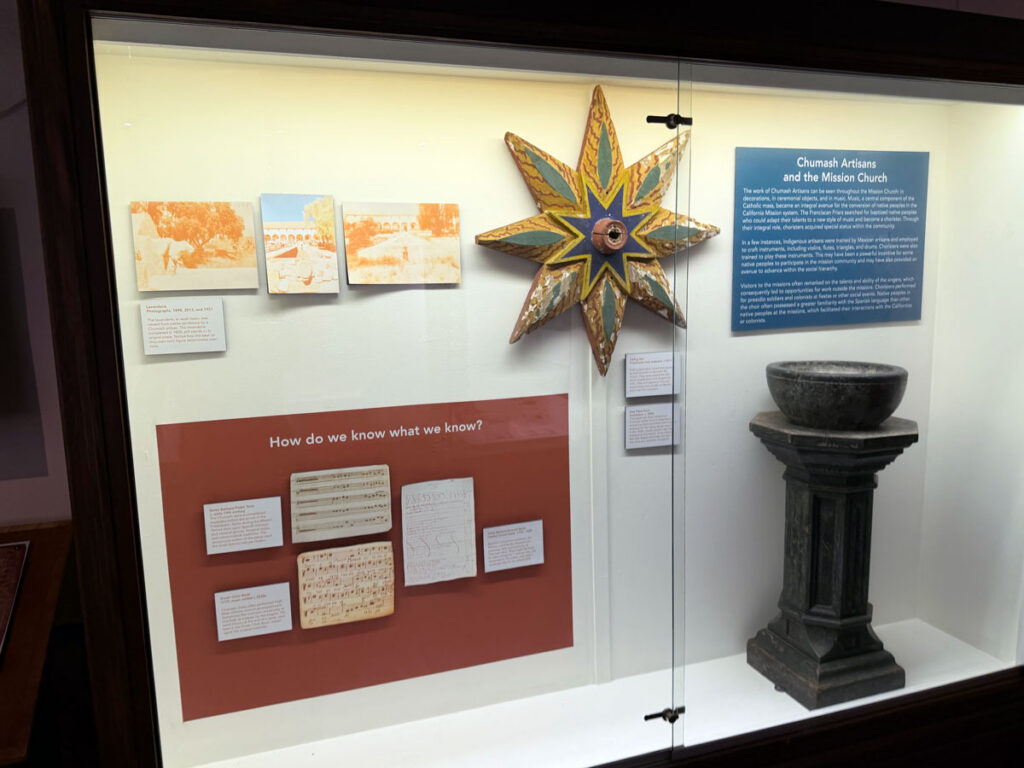
Tip:
The museum’s Chumash exhibits reward slowing down. A case near the entrance, “Before and at Contact,” lays out population estimates for Chumash villages in the Santa Barbara area before Spanish arrival — a level of specific, sourced detail that’s easy to miss if you’re moving quickly toward the church.
The Facade and Twin Bell Towers
Earthquakes are the reason the building looks the way it does. An 1812 earthquake destroyed the mission’s earlier adobe church, and the stone structure built in its place, finished in 1820, borrowed its proportions loosely from a Roman Ionic temple — a genuinely unusual design choice among the California missions, most of which stuck to simpler Spanish Colonial forms. The mission originally had just one bell tower; the second was added in 1831, giving the facade its now-iconic symmetry. A second major earthquake in 1925 damaged the building again, requiring extensive restoration.
Read more: Catalina Island Travel Guide 2026
The Mission remains an active Catholic parish today, which is part of why the facade you photograph might have a wedding taking place on its front steps — the church still hosts services, weddings, and funerals on a regular schedule, and the self-guided tour is built to work around them.
The Bells Themselves
Inside the museum, a retired 1836 bell named Nuestra Señora de Guadalupe is displayed at close range — visitors are invited to touch it, running their hands over its lettering. At 223 pounds, it’s a fraction of the mission’s full bell history: the mission began with two bells in 1787, added two more in 1797, another in 1804, and had grown to six bells in one tower by the time the 1820 church was completed, and eight once the second tower went up in 1833.
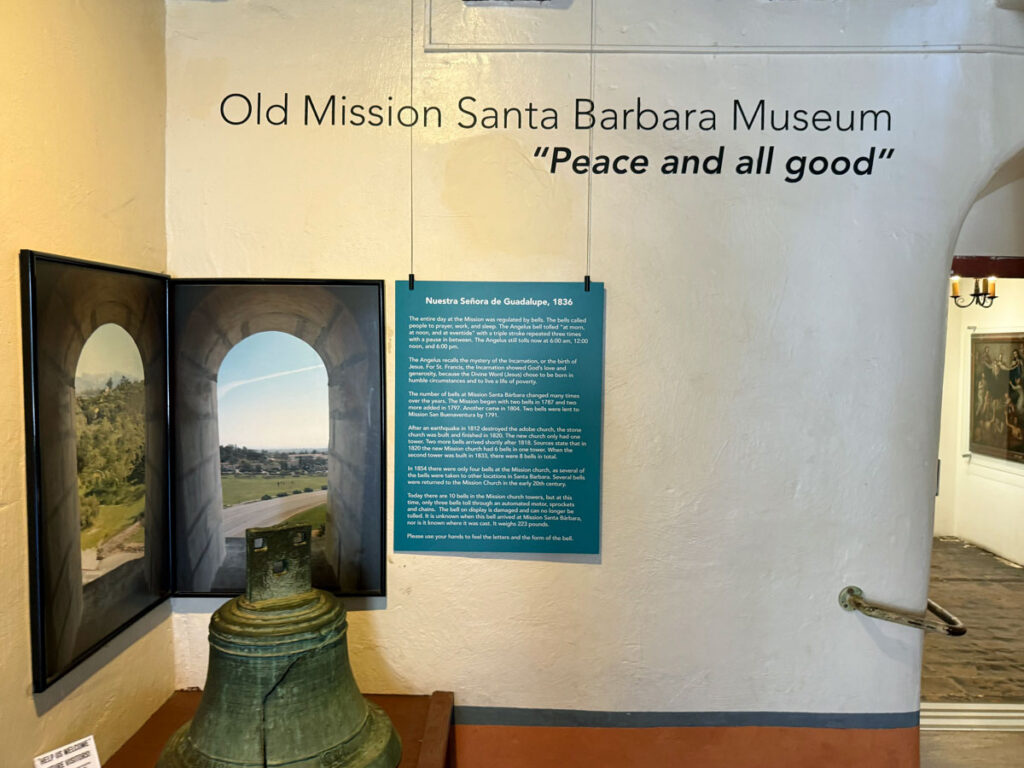
The bells’ schedule wasn’t decorative. Historically, they regulated the entire day at the mission — calling people to prayer, work, and sleep, with an Angelus bell tolled at 6 a.m., noon, and 6 p.m. that’s still rung today. Of the ten bells currently in the towers, only three are tolled now, through an automated motor and chain system.
The Museum: Art, Artifacts, and a Working Altarpiece Room
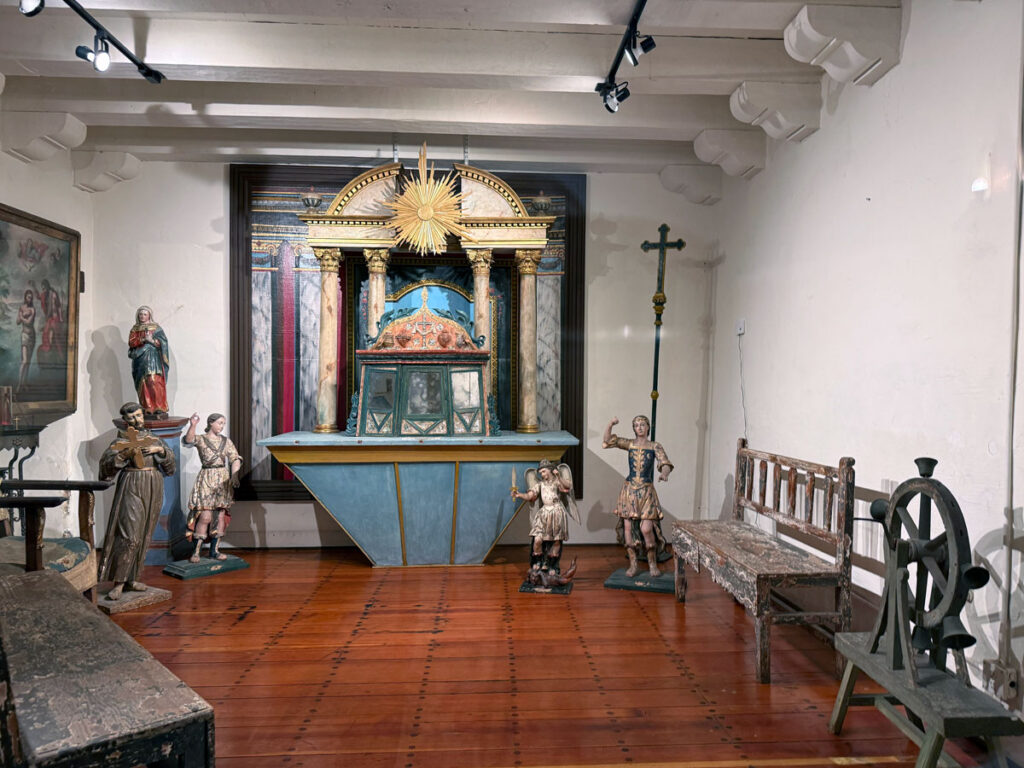
Beyond the Chumash exhibits, the museum’s nine rooms hold a genuinely dense collection of mission-era religious art — painted wooden statues of saints, an ornate gilded altarpiece, and furnishings that give a sense of how elaborate the church’s interior decoration became over two-plus centuries.
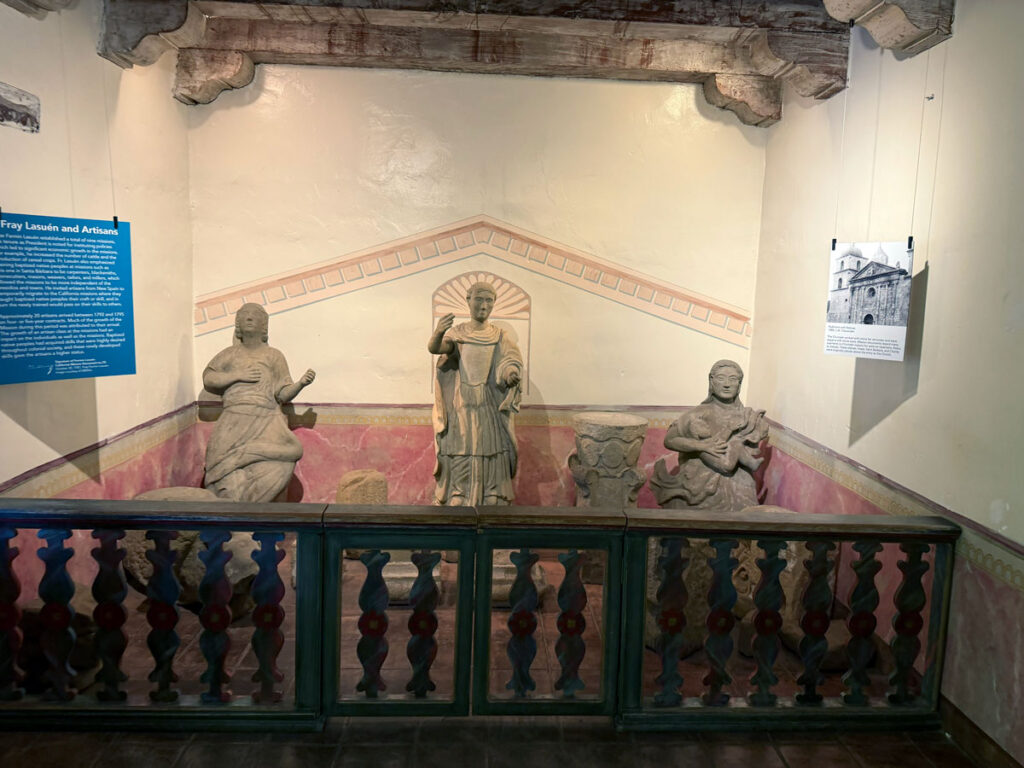
A room dedicated to Fray Lasuén and the artisans he brought to train native craftspeople displays weathered statuary that once adorned the mission directly — a more intimate, close-up look than what’s visible from the pews during a service.
The Inner Quadrangle Gardens
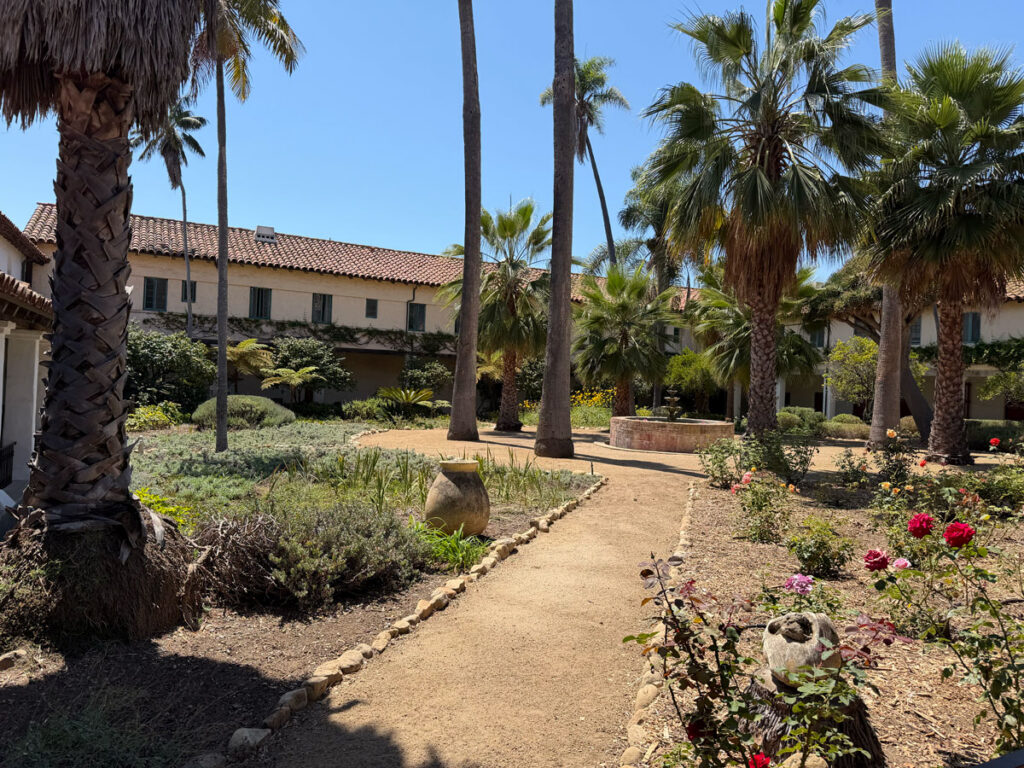
Behind the church, the Inner Quadrangle has been a garden space since the earliest days of the mission, though its current layout dates to 1873, when Fray José María Romo redesigned it with geometric beds and walkways radiating from a circular fountain. The arrival of German Franciscan friars in 1885 brought further changes to the plantings, and today the space mixes towering palms with roses and Mediterranean shrubs around that same central fountain.
Tip:
A friar still sews and repairs habits in a tailor shop just off the garden — a small, easy-to-miss detail that connects the space to the mission’s ongoing life as a working Franciscan community, not just a historical exhibit.
The Lawn, the Cross, and the View
The open lawn in front of the church has its own history: it was a vineyard until 1913, when it was replaced with grass and a formal cross was erected under the direction of the German friars who’d arrived a few decades earlier. Today it’s simply the best place to sit, picnic, or take in the mission’s full facade without a ticket.
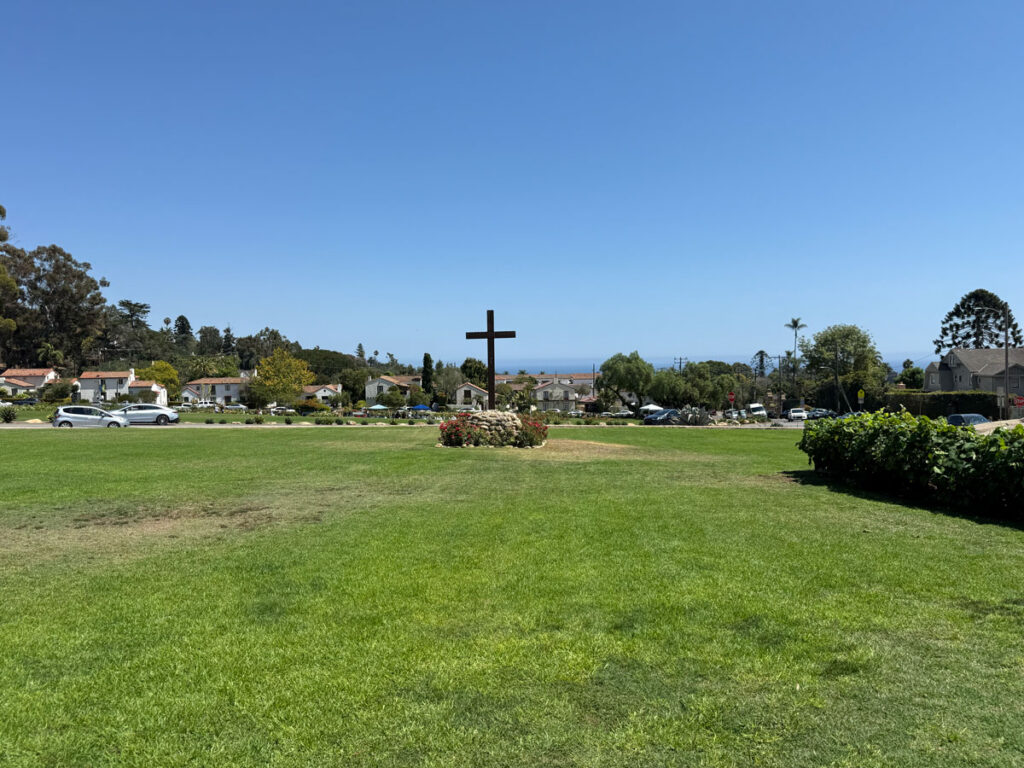
On a clear day, gaps in the surrounding trees and rooftops still offer a glimpse toward the Pacific — a reminder that the mission’s builders originally chose this spot for its unobstructed view of both the ocean and the Santa Ynez Mountains behind it.
The Gift Shop
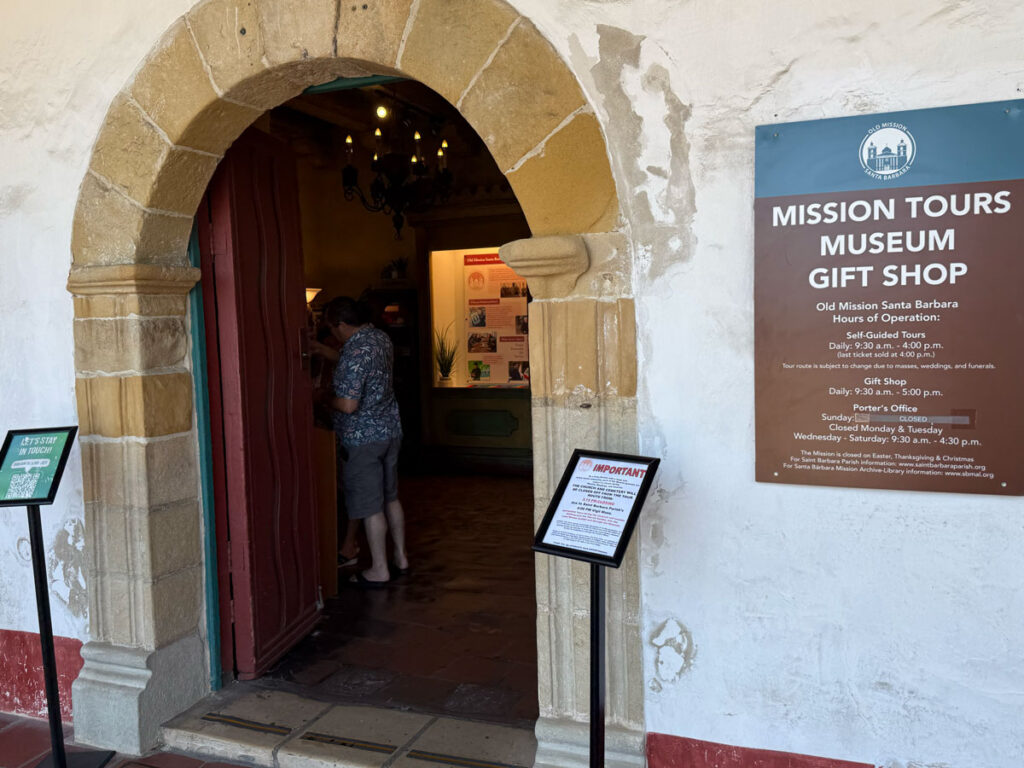
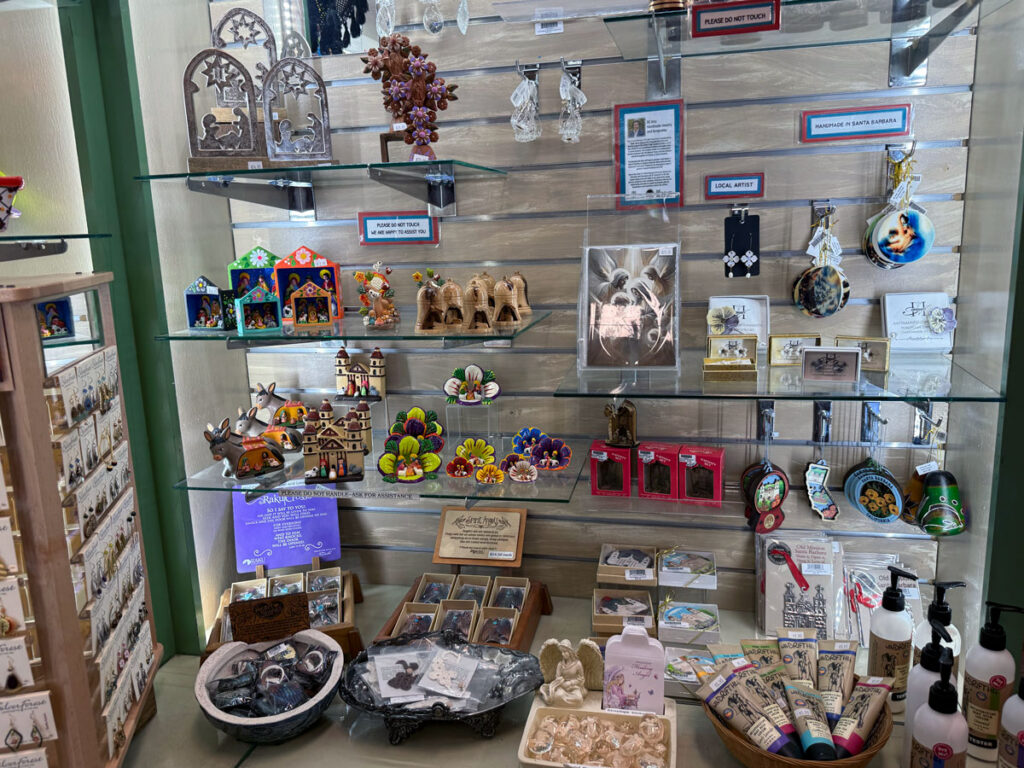
The tour route deliberately funnels out through the gift shop, which sells the expected range of mission-branded and locally made goods — jewelry from area artisans, mission figurines, and locally produced skincare and wine among them.
Prices run from a few dollars for a postcard or ornament up to considerably more for handmade jewelry pieces, so it’s easy to find something at whatever budget you’ve got left after admission.
Go early or go late. The mission is one of Santa Barbara’s most-visited landmarks, and tour buses tend to cluster mid-morning; arriving close to opening (9:30 a.m.) or a couple of hours before the last ticket (4 p.m.) means smaller crowds.
Budget 30–40 minutes for the self-guided tour. It’s a genuinely quick visit unless you slow down deliberately in the museum rooms, which is where most of the depth is.
Bring your EBT card if you have one. The Museums for All program drops admission to just $3 — a significant discount worth knowing about.
Cross the street afterward. The A.C. Postel Memorial Rose Garden, directly across from the mission, is free, with more than 1,500 rose plants and one of the best angles on the twin towers.
Check for weddings before planning around the church interior. Saturday weddings are typically scheduled 12–2:30 p.m.; the church and cemetery close to tour traffic during that window, though the rest of the route stays open.
Staying in Santa Barbara for the visit? Booking.com promotion: up to 20% off travel deals at Booking.com is worth checking before you book a room, since rates near the Mission and downtown can vary a lot by season and how far ahead you reserve — comparing a few dates only takes a couple of minutes.